Tuesday, January 20, 2015

2015 Mock Newbery discussions at Emerson, part 1: Blossoming Universe of Violet Diamond + Brown Girl Dreaming

Our 4th and 5th graders are buzzing with excitement from our Mock Newbery discussion and voting. We have been reading and reading, sharing books and ideas, trying to figure out what makes a book truly distinguished. This past week, we've had two lunchtime book club meetings for our final discussions and voting. Just look at our turnout!
2015 Mock Newbery discussion at Emerson School
Over the next several days, I will try to share my students' thoughts on our books. Each student has tried to read at least five books from our nominated books (see here for more about our process), and all were working hard to compare very different books with each other. I want other librarians, parents and kids to be able to hear some of their comments.

There is no way that our small group could read all the books that the Newbery Committee will be discussing. I wanted a representative sample that fell within our 4th and 5th grader's range. This year, I also wanted to give the students more responsibility and voice in nominating books to consider.

I think I've inspired new admiration from our group about just what the Newbery Committee must do -- from the amount of reading to the hard, hard decisions. I will discuss each book, simply in alphabetical order. Here are the posts on our Mock Newbery:
Part 1 -- The Blossoming Universe of Violet Diamond + Brown Girl Dreaming
Part 2 -- The Crossover + Dash + The Fourteenth Goldfish
Part 3 -- The Great Greene Heist + Half a Chance + The Life of Zarf
Part 4 -- Magic in the Mix + Nest + The Night Gardener
Part 5 -- Nuts to You + The Red Pencil + Snicker of Magic
Part 6 -- The Swap + Witch's Boy + Zoo at the Edge of the World
Part 7 -- OUR WINNER!!!
Our book club actually start last spring, much like the Newbery Committee does, excitedly reading new releases. One of the first books that quickly grabbed readers and rose to the top was The Blossoming Universe of Violet Diamond.
The Blossoming Universe of Violet Diamond
by Brenda Woods
Nancy Paulsen / Penguin, 2014
Your local library
Amazon
ages 9-12
Emerson's fourth and fifth graders were drawn to the way that Violet Diamond slowly builds a relationship with her grandmother, and how she discovered more about herself, her family and her identity in the process. Violet is biracial, like many of our students; but she never knew her African American father because he was killed in an automobile crash before she was born.
making notes for the Mock Newbery discussion
It was interesting that the students who really liked this book didn't speak up much about it. Perhaps it's because they read this in the beginning of the year. Or perhaps it's because it appealed to quieter readers. I just know that it stayed with my students, persisting to our final round of voting.

Brown Girl Dreaming was another book that probed identity, family and self-discovery -- but this book drew a much more vocal reaction from my students.
Brown Girl Dreaming
by Jacqueline Woodson
Nancy Paulsen / Penguin, 2014
2014 National Book Award winner
my full review
Your local library
Amazon
ages 10-14
Woodson weaves together the story of her childhood, built from her family's memories as well as her own. She writes her memoir in verse, capturing the episodic, sensory-rich feeling of memories. As we talked about characters, Kaiyah spoke up, saying how well she got to know the characters in Brown Girl Dreaming from the dialog.
"In the first chapter, you can really understand what the dad was like and the mom, and the conflict between the two, because of how they wanted to name their daughter and how they talked." 
Other students agreed, saying how they got to know a wide range of characters, not just Jackie. Her brother and sister, her grandparents, her mother were all really well developed and distinct, showing you what different family members were thinking and feeling.
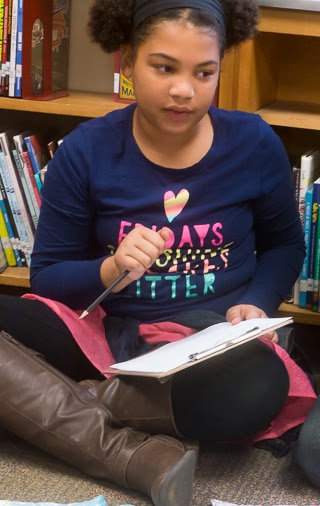
Moreover, my students commented how much they could connect to Jackie. Elani and Josselin said, "It's like we are actually in the book." Angel elaborated, explaining:
"Jacqueline Woodson described her own experiences so well that I knew how she felt, and I have experienced some of the same things, so I felt like she would understand how I feel."
Kaiyah and Angel also noted how well Brown Girl Dreaming captured the different settings, from rural South Carolina to urban New York City. Small interior images also stayed with our readers, like when Woodson's baby brother was eating paint chips from the wall.

I was impressed how articulate and passionate our Brown Girl Dreaming readers were. While this isn't necessarily a book for a wide audience within a classroom, it goes deep for the readers it touches, staying with them for a long time.

The review copies were kindly sent by the publisher Nancy Paulsen and Penguin Books for Young Readers, and we have purchased additional copies for our school library. If you make a purchase using the Amazon links on this site, a small portion goes to Great Kid Books. Thank you for your support.

©2015 Mary Ann Scheuer, Great Kid Books

Wednesday, January 14, 2015

Poetry in motion: Terrific virtual visit with Kwame Alexander (ages 10-14)

"Oh man, I love that book." -- that's Theo, one of my 5th graders, when I told them last week that we were going to Skype with Kwame Alexander, the author of The Crossover. How cool is that? Just hearing Theo sigh and declare his love for a book was enough to melt my heart. But now we are all soaring, with all the inspiration, smiles and love from our visit this week.

Huge thanks go out to Kwame Alexander -- first for writing a book with so much heart, so much swag, so much appeal that it's got kids passing it from friend to friend. But also for taking his time to visit with us.

You can get a sense of what it's like for our students to Skype with Mr. Alexander in this picture below. Two fifth grade classes gathered in the library (about 50 kids), of whom about 15 had already read The Crossover. We first listened to Kwame tell us about the book, but the bulk of our time was spent asking questions back and forth.
Skyping in the Emerson library with Kwame Alexander
As students started asking questions, I captured some of what Kwame was saying. I'd like to share a few excerpts here.
"Basketball is like poetry in motion."

Asking Mr. Alexander a question
"I was inspired to write this book by my relationship with dad. He was a really good basketball player, like Josh & JB's father, but I wasn't. I played tennis instead. I also wanted to this because I love basketball so much. And I wanted to write a book that boys (and girls too) would really want to read, and I knew that basketball would draw a lot of kids in."

"Why did you write this story as a novel in verse? Because poetry is the coolest form of writing on the planet, and I happen to be the coolest dude on the planet! But it's more than that -- poetry is rhythmic and concise, and when you do it write, poetry has a lot of swag. This is just like basketball -- players have rhythm, movement, a lot of swag. A novel in verse also doesn't have a lot of words on a page, so kids who don't like to read won't be intimidated by this book. That was important to me."
One student asked what the first novel in verse was that he read, and Kwame talked about how Love That Dog by Sharon Creech was just amazing. Then he asked her what other novel in verses she liked. When she told him that she loved Words With Wings, by Nikki Grimes, Kwame took out his phone and texted her! Then he took this selfie to show Nikki!!
We asked him about what you do when you get stuck writing. Kwame asked if any of us played soccer. When you play soccer, you do a lot of running, but you aren’t always scoring goals. Writing is like that. You write and write and write, and eventually something will click and you’ll score. The Crossover took Kwame five years to write.

Here’s how he goes about writing a poem.
  1. Somebody tells me what I have to write about, or I have to figure out my topic
  2. I make a list of as many words I can think of about that topic. I write down 30-50 words.
  3. I think about the structure -- what kind of poem am I going to write? Maybe I’m going to borrow a poem, model this poem on a poem I really like.
  4. Then I take my list of words and start fitting them into that structure. I add verbs or adjectives to link the words together, connect them, and keep playing.
Special thanks to Kwame for taking time out of his writing day to visit with us. And special thanks also go to the Berkeley Public Schools Fund and our school PTA that made this visit possible. If you're at all inclined to try out Skyping with an author, reach out and see if they're interested.

If I could, I would send every 5th grade teacher a copy of The Crossover. Not only can it capture kids' attention, but it holds them there with an emotionally resonant story told with powerful, crafted language. The review copy came from our school library. If you make a purchase using the Amazon links on this site, a small portion goes to Great Kid Books. Thank you for your support.

©2015 Mary Ann Scheuer, Great Kid Books

Monday, January 12, 2015

Emmanuel’s Dream: The True Story of Emmanuel Ofosu Yeboah by Laurie Ann Thompson and Sean Qualls (ages 5-9)

Children are drawn to books in part to see themselves reflected, but also to look into the lives of other people far away. I think truly wonderful books can help us do both. Emmanuel's Dream tells the inspiring story of Emmanuel Ofosu Yeboah, who was born in Ghana with one deformed leg. He faced life with courage and fortitude, and his story helps readers think about how we face life's challenges.
Emmanuel's Dream
The True Story of Emmanuel Ofosu Yeboah
by Laurie Ann Thompson
illustrated by Sean Qualls
Schwartz & Wade / Random House, p2015
Your local library
Amazon
ages 5-9
*best new book*
From an early age, Emmanuel's mother encouraged him to go after what he wanted. Even though one of his legs was deformed, he hopped more than two miles each way, learned to play soccer, and even learned to ride a bike with his friends. In 2001, Emmanuel rode his bicycle four hundred miles across Ghana to spread his powerful message: disability is not inability.
"As Emmanuel grew, Mama Comfort told him he could have anything,
but he would have to get it for himself."
Laurie Ann Thompson
Today, I have the honor of starting off a blog tour celebrating the publication of Emmanuel's Dream with an interview with Laurie Ann Thompson.

Mary Ann: How did you first find out about this story?
Laurie: I first learned about Emmanuel’s inspiring story when he appeared on the Oprah Winfrey Show in 2005 at the launch of Emmanuel’s Gift, a documentary about his life narrated by Oprah herself. On her show, Oprah said, “I think every parent should go take their children to see this movie because it will change the way your children think about what they can do and can be.” I agreed, but as a children’s book author I thought it would be even better if every parent could share Emmanuel’s story with their child through a book!

Mary Ann: Then how did you go about learning more about Emmanuel?
Laurie: First, I bought the movie and watched it over and over again. Then, I did research online and through library databases to find newspaper and magazine articles about Emmanuel and his activities. Finally, in 2010, I had the honor of meeting Emmanuel and interviewing him in person. After that meeting, I had 18 pages of typed, single-spaced notes to add to my research file! Since then, Emmanuel and I have kept in touch by email and phone, so he was able to answer all of my follow-up questions directly.
Emmanuel Ofosu Yeboah and Laurie Ann Thompson in San Diego
Mary Ann: What was really interesting or surprising to you?
Laurie: What I love most about Emmanuel’s story is how thoughtful he was about what he was trying to accomplish. He’s an incredible athlete, yes, but he’s also very intelligent and observant, and his ride was more than just a physical pursuit. He specifically chose a sport, cycling, that most people think would require two legs. He hired a photographer to document his journey along the way. And he intentionally arranged meetings with key government officials and religious leaders all along his route so that his story would be featured in newspapers and magazines and on radio and television. This careful cultivation of the right kinds of media attention was a huge factor in his success.

Mary Ann: When you read this story with children, what do you find they really connect to in Emmanuel's story? What inspires you about children's reactions?
Laurie: Since it just came out, I actually haven’t had a chance to read it with very many children yet, but what attracted me to the story was the fact that Emmanuel was such an underdog. He wasn’t expected to do anything important with his life—he was expected to become a beggar. First, he ignored that expectation, and then he completely turned it on its head! The setting will certainly be unfamiliar to most readers in the United States, and many children won’t be able to relate to being disabled and but I think all of us, especially children, can relate to that feeling of being underappreciated, of someone else’s expectations for us coming in disappointingly, frustratingly low. I hope that after reading the book children will give themselves permission to follow their own dreams and live up to their own potentials, regardless of what others may tell them is possible or not. I think that’s the real power behind Emmanuel’s story, and what I most wanted to convey.

Thank you so much, Laurie, for taking the time to share your thoughts on this beautiful story. I absolutely agree -- I think that this story helps children look inside themselves to see how they can be courageous, how they can live up to their potentials no matter what others tell them.

I look forward to following all the stops on Laurie's blog tour.
Mon, Jan 12: Great Kid Books
Tues, Jan 13: 5 Minutes for Books
Wed, Jan 14: Unleashing Readers
Thurs, Jan 15: Sharpread
Fri, Jan 16: Cracking the Cover
Sat, Jan 17: Booking Mama
Mon, Jan 19: Once Upon a Story
Tues, Jan 20: Proseandkahn
Wed, Jan 21: Geo Librarian
Thurs, Jan 22: Nonfiction Detectives
Fri, Jan 23: The Fourth Musketeer
Mon, Jan 26: NC Teacher Stuff
Tues, Jan 27: Teach Mentor Texts
Laurie Ann Thompson is the author of Be a Changemaker: How to Start Something That Matters, a how-to guide for teens who want to change the world. An advocate for social justice, Laurie is dedicated to inspiring and empowering young readers. Emmanuel's Dream is her picture-book debut. Visit her at lauriethompson.com.

Illustration © 2015 by Sean Qualls from EMMANUEL'S DREAM: THE TRUE STORY OF EMMANUEL OFOSU YEBOAH by Laurie Ann Thompson; published by Schwartz & Wade Books, an imprint of Random House Children's Books, a division of Random House LLC, a Penguin Random House Company

The review copy was kindly sent by the publisher Random House Books. If you make a purchase using the Amazon links on this site, a small portion goes to Great Kid Books. Thank you for your support.

©2015 Mary Ann Scheuer, Great Kid Books

Saturday, January 10, 2015

The Madman of Piney Woods, by Christopher Paul Curtis -- poignant historical fiction (ages 10-13)

With so many tragedies in the news lately, I've been wondering what causes some people to react to life's hardships with hatred and bitterness when others react with empathy and understanding. As I finished reading Christopher Paul Curtis's moving novel The Madman of Piney Woods, the characters gave me strength to face life's hardships and reflect on what's important. This is a companion novel to his Newbery Honor book Elijah of Buxton, but it easily stands alone.
The Madman of Piney Woods
by Christopher Paul Curtis
Scholastic, 2014
Your local library
Amazon
ages 10-13
*best new book*
Thirteen year old Benji Alston lives in Buxton, Ontario and dreams of becoming a newspaper journalist. The Civil War happened long ago, but its impact still resonates in Buxton, a Canadian town settled by abolitionists and runaway slaves. African-Canadian Benji is excited to start an internship at a local newspaper in nearby Chatham, where he meets Alvin "Red" Stockard, son of an Irish immigrant and a local judge.

Curtis slowly builds this story, immersing readers in each boy's separate life--showing their interactions with friends and family. African-Canandian Benji is most at home in the woods, but he is not a perfect character. He's exceedingly jealous of his younger brother and sister, teasing and tormenting them. Red is the sort of person who watches a situation closely, noticing how people act and interact. It's no surprise when we find out that he dreams of becoming a scientist.

Both boys come across a man--perhaps real, perhaps mythical--living in the woods whom local children fear. Through Benji, readers comes to know The Madman of Piney Woods and learn about the horrors of the Civil War that made him retreat from society. But readers also come to know Red's Irish grandmother and the "coffin ships" that carried her to Canada--and how those experiences led her enduring bitterness.

I know this will be a hard book to summarize for students. It's the sort of book you have to find your way through, trusting friends' recommendations and the author. But it has lasting power, both in its overall themes and in specific passages. On his deathbed, the "Madman" Mr. Bixby gives this final advice to Benji:
“You gotta be careful, boy. Life ain’t fair; it ain’t got no conscience ’bout letting one bad choice you make as a child be the thing what colour every waking minute you has thereafter. You gotta remember to treat each moment and each person as precious, treat ’em all with the same respect I seent you treating them woods.”
Benji has the last word with his first published article, a eulogy for Mr. Bixby which captures the lasting message I take away from this book.
"He is a hero because, in spite of all the horrors he’d witnessed, he never allowed anger nor vengeance to poison his spirit. he is a hero because though surrounded by the ignorance of his fellow man, he never became bitter."
I finished this book feeling like I was a better person for having read it. It reaffirmed my resolutions to keep connected to friends and family, to appreciate life's small moments and special people.

My students love Christopher Paul Curtis's novels Bud, Not Buddy and The Watsons Go to Birmingham. It's interesting that few read Elijah of Buxton. I look forward to encouraging more to trust a favorite author and read this. It will be a perfect fit for students who seek poignant stories, appreciate masterful writing and enjoy becoming immersed in characters' lives.

The review copy was kindly sent by the publisher Scholastic Press. If you make a purchase using the Amazon links on this site, a small portion goes to Great Kid Books. Thank you for your support.

©2015 Mary Ann Scheuer, Great Kid Books

Sunday, January 4, 2015

Celebrating the new year with books for new readers (ages 4-8)

I love the excitement in the air with little kids going back to school. I am looking forward to celebrating by sharing three new favorite books for beginning readers. These all incorporate humor with simple words that children just learning to read can decode. I'm going to keep the descriptions short so you can see a nice variety of books.
Steve & Wessley inThe Ice Cream Shop
by Jennifer E. Morris
Scholastic Level 1
Scholastic, 2014
Your local library
Amazon
ages 4-8
When Steve passes an ice cream shop, he knows he can't walk another step without going inside. But push as he might, he just can't get the door open. Nothing happens until his best friend Wessley comes by and helps Steve read the sign: PULL. Kids will love the cartoon style, with exaggerated expressions and simple dialog. Also see Steve & Wessley in The Sea Monster for more of the same fun.

I Said, "Bed!"
An I Like to Read book, level D
by Bruce Degen
Holiday House, 2014
Your local library
Amazon
ages 4-7
A rambunctious boy does NOT want to go to bed. "Bedtime is boring," he tells his mom. But when his bed turns into a motocross bike, the little boy is all ready for an adventure. I love the way Degen combines spirited illustrations with very simple text. Lots of room for imagination, but simple words for beginning readers.

This hardback book is a large picture-book size (8"x10"). In our library, that means it will get lost among all of our other picture books. I wonder if parents like this large format size. In the library, I tend to prefer these very beginning readers to keep to the traditional beginning reader trim size (5"x8").
Clara and Clem in Outer Space
Penguin Young Readers, Level 1
by Ethan Long
Penguin, 2014
Google Books preview
Your local library
Amazon
ages 4-7
Clara and Clem head to outer space on a rocket they build together. They zoom past stars and dodge hungry aliens. Very beginning readers will enjoy the simple rhyming words and colorful cartoon illustrations. Each page has only one or two words in large dialog cartoon bubbles. Take a look at the Google Preview to get a sense of the pacing. Ethan Long is a master combining simple dialog with lively illustrations, winning the Geisel Award last year for Up, Tall and High. I'm so happy to have discovered a new series of his!

I am excited to explore the newly announced Cybils Award shortlist for Early Readers, which is what directed me to several of these titles. The review copies came from my personal library. If you make a purchase using the Amazon links on this site, a small portion goes to Great Kid Books. Thank you for your support.

©2015 Mary Ann Scheuer, Great Kid Books

Thursday, January 1, 2015

Brown Girl Dreaming, by Jacqueline Woodson -- savoring memory, family and dreams (ages 9-14)

I am filled with love and hope as we step foot into the new year. I spent the day going on a beautiful walk in the crisp sunshine and then rereading my favorite book of the past year: Brown Girl Dreaming, by Jacqueline Woodson.
If you have a thoughtful, contemplative child in your life, seek out this book. If you want savor the richness of memory, family and dreams, seek out this book. If you want to revel in the beauty of language, by all means seek out this book.
Brown Girl Dreaming
by Jacqueline Woodson
Nancy Paulsen / Penguin, 2014
winner of 2014 National Book Award for Young People
Your local library
Amazon
ages 9-14
*best new book*
Woodson has long been one of my favorite writers, drawing readers into emotionally powerful stories. Here she digs deep into her own childhood, writing in free verse to capture the images and feelings that come with those memories. Her language is rich in metaphor and imagery, exploring the way memories stay with us.
"My grandmother tells us all this
as we sit at her feet, each story like a photograph
we can look right into." 
As I read Woodson's memoir, I'm filled with the love for my own grandfather. Even though he was so very different than Woodson's grandfather, the strength of her memories evoke my own remembrances. I feel "the weight of our grandparents' love like a blanket with us beneath it, safe and warm."

But most of all, I love reading how Woodson talks about her dream of becoming a writer, her realization that words and stories are her special gift: "songs and stories and whole new worlds tucking themselves into my memory." Woodson excels at conveying her particular memories, but also connecting her life to a universal experience.
"How can I explain to anyone that stories
are like air to me,
I breathe them in and let them out
over and over again."
When I first read Brown Girl Dreaming last spring, I wondered how children would respond to it: Was this more of a book that adults would appreciate? Will children relate to her journey? Throughout the fall, I've watched it light a spark in students. It isn't the book for every child, but it is a truly special book for those it reaches. I just wish you could have seen two fourth graders who read it together and gushed how they see themselves in Woodson's words.

I am excited that my students have nominated Brown Girl Dreaming for our Emerson 2015 Mock Newbery. It will be fascinating to hear our passionate readers talk about what this book meant to them, whether they see Woodson's writing as distinguished and how it compares to other books they've read this year.

Teachers will also love using excerpts to inspire their students' own writing. Here are two of my favorite images:
"The empty swing set reminds us of this--
that what is bad won't be bad forever,
and what is good can sometimes last
a long, long time.

Even Coraandhersisters can only bother us
for a little while before they get called home
to supper."
---------------------
"When I read, the words twist
twirl across the page.
When they settle, it is too late.
The class has already moved on.

I want to catch words one day. I want to hold them
then blow gently,
watch them float
right out of my hands."
Please share this exceptional book with children who want to savor language, revel in memories and dream of being a writer.

Here are some interviews with Jacqueline Woodson I have especially loved reading, watching and listening to:
The review copy came from my personal library. I have already purchased several copies, although the first review copy was kindly sent by the publisher Nancy Paulsen and Penguin Books for Young Readers. If you make a purchase using the Amazon links on this site, a small portion goes to Great Kid Books. Thank you for your support.

©2015 Mary Ann Scheuer, Great Kid Books