Monday, January 26, 2015

2015 Mock Newbery discussions at Emerson, part 5: Nuts to You, The Red Pencil + Snicker of Magic

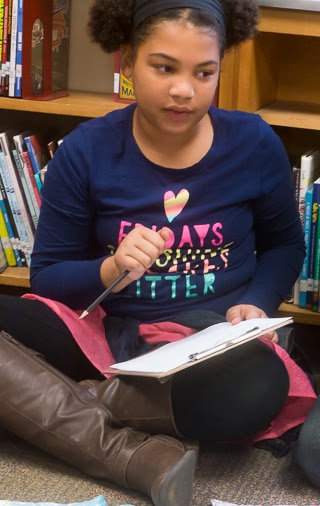
Listening and sharing ideas in our Mock Newbery discussions
In our Mock Newbery book club, students were able to choose which books they wanted to read. In order to vote, they had to read five or more of the nominated titles. I wanted to give them freedom to choose what to read, but I also really enjoyed listening to them recommend titles to one another. We had informal book club meetings once a week for lunch in the library, and then we met in January for our final discussions. Many students chose to read today's three books--I hope I can capture some of their comments.
Nuts to You
by Lynne Rae Perkins
Greenwillow / HarperCollins, 2014
Your local library
Amazon
ages 8-11
Right from the beginning, students started talking about how Nuts to You was both funny and full of adventure. After a hawk captures the unsuspecting squirrel Jed, his friends TsTs and Chai are sure that he's still alive. They set off following a trail of "buzzpaths" and "frozen spiderwebs" (electrical lines and utility towers) to rescue him. I love that the kids responded to the satirical footnotes and twists in language. Just take this example from near the beginning:
“To squirrels, ‘Are you nuts?’ is a combination of ‘Have you lost your mind?’ and ‘You remind me of the most wonderful thing I can think of.’”
Some students had trouble getting into this story and found the tone or perspective confusing. Maisy said at one meeting that she was half-way through the story and didn't quite see what's funny about it yet. McKenna told her that it starts getting funnier and funnier as you start getting more into the book--in fact, she wondered if it would be funnier the second time you read it. Talia and Gwen definitely agreed with McKenna.
The Red Pencil
by Andrea Davis Pinkney
Little Brown, 2014
Your local library
Amazon
ages 9-12
Students consistently mentioned The Red Pencil not only as a powerful, touching book, but also one that they could really understand what the characters were going through even though it was so different from their lives. When the Sudanese rebels attack her village, young Amira's home is destroyed and her whole life is upended. She escapes to a refugee camp, but what about her dreams of going to school?

When we were discussing plot and pacing, Corina expanded on why she thought The Red Pencil was so effective:
"I felt like I always knew what was going on even though it wasn't familiar to me. Each small moment, the author would break it down so you knew how everyone was feeling about it. You didn't know what was going to happen next -- you felt like you were in the present of the story and were right there with the characters."--Corina
I just went back and checked -- it's fascinating that Pinkney writes this in the present tense. Amira's emotional journey was important to students. She had to escape her war-torn home, and she also had to discover how to navigate following her own dream of learning to read and write despite her mother's traditional views.
Snicker of Magic
by Natalie Lloyd
Scholastic, 2014
Your local library
Amazon
ages 8-12
Just look at all those post-it notes--so many kids read Snicker of Magic. We all agreed that kids liked it, but during our Mock Newbery discussions we tried to explore why the story and writing were especially good. When Felicity Pickle moves to Midnight Gulch, Tennessee, our readers could tell right away that she was lonely--but Nia's comment to book club back in October was: "She think the word lonely is really really strong to say." Time and again, students mentioned how Felicity sees words, but they also noticed how the author really shows readers how Felicity feels. This magical element helped them see deeper into Felicity's feelings and Lloyd's themes.

This mix of magical fantasy elements in a real-life setting appealed to many readers. They loved the details like blueberry ice cream that helps you remember lost memories, and they could relate to many of the characters. A few mentioned that the pacing seemed a bit uneven ("sometimes it speeded up and then other times it was really slow or went off into something that didn't go with the plot") but others strongly disagreed and liked the way different plot elements wove together.

In our discussions we didn't have enough time to explore the themes of the stories, but I firmly believe that those underlying themes are a major reason why these different stories all appealed to readers. Whether it's TsTs' loyal friendship in Nuts to You, Amira's resiliency in The Red Pencil or the Beedle's generosity in Snicker of Magic, each of these deeper themes resonated with readers in lasting ways.

The review copies came from my home collection and our library collection. Early review copies were also kindly sent by the publishers, HarperCollins, Little Brown and Scholastic. If you make a purchase using the Amazon links on this site, a small portion goes to Great Kid Books. Thank you for your support.

©2015 Mary Ann Scheuer, Great Kid Books

Sunday, January 25, 2015

2015 Mock Newbery discussions at Emerson, part 4: Magic in the Mix + Nest + The Night Gardener

getting ready for book club -- each week, I took notes
What draws us into great stories? Is it the chance to see a glimpse of ourselves in other people? Is it getting lost in another world, so far from our own? Or maybe it's getting swept away by an exciting plot, full of suspense and danger. As we met each week, I loved listening to my students recommending books to one another each week during our book club lunches, hearing what they loved and what captured their interest.
Magic in the Mix
by Annie Barrows
Bloomsbury, 2014
Your local library
Amazon
ages 8-12
Many kids are drawn to stories with characters that inspire them because of their courage and bravery. Molly and Miri return from The Magic Half, but they are the only ones in their family who know that they haven't always been twin sisters. Molly and Miri's brothers always annoy them, but when the brothers stumble through the time portal that Molly and Miri have opened, the twin sisters know that it's up to them to rescue their brothers.

Our 4th and 5th graders all commented about how much they could imagine these characters, how the story pulled them through, and how they liked the mix of time-travel fantasy and historical fiction.
"I liked learning a little bit about the Civil War, but not too much."
"I could really see Molly and Miri and how brave they were helping their brothers."
"When they were scared, walking through the forest, I could feel like I was right there."
In the end, Magic in the Mix was read and enjoyed by many students (our two copies have circulated 25 times already!), but it didn't rise to the top of many final voting lists.
Nest
by Esther Ehrlich
Wendy Lamb / Random House, 2014
Your local library
Amazon
ages 10-14
Eleven-year-old Naomi "Chirp" Orenstein is devoted to her mother, but life starts to fall apart when Chirp's mother is hospitalized for depression. When I first read Nest, I wasn't sure if it was right for an elementary school library, but several of my early readers were adamant that it was an amazing book that should be in our library. Angel and Corina wrote in their nomination,
"It's not a happily ever book, but it shows how much a girl and her family care and love each other after various tragedies.They may not end up with a perfect life but I found it was even better that way."
Nest is suited for students who like heartfelt stories that linger with you. Some students who like realistic fiction could tell that it was too sad, and stopped reading. Speaking with middle school librarians, it's finding a wider audience there. This is definitely a story that makes readers think long after they've turned the last page. What I loved about my students' reactions is how much they related to Chirp's inner strength as she copes with her mother's illness.
The Night Gardener
by Jonathan Auxier
Amulet / Abrams, 2014
my full review
Your local library
Amazon
ages 10-14
Students who read The Night Gardener held it up as an example for masterful plot, setting and character development. "I could see how the tree was built right into the house," said Amelie. "I really imagine the house, seeing how it was old now, but also how it used to be." The setting was integral to creating the frightening tone for the story, especially the suspense that kept students reading. Kaiyah specifically mentioned that she felt right in the forest when Molly and Kip were in their wagon heading toward the Windsor's estate.
friends discussing books for Emerson's Mock Newbery
It's interesting -- I think both The Night Gardener and Nest might be seen as "more appropriate" for middle school students, but are ones that my students advocated strongly for including in our library. They are both emotionally intense stories, but I've found that students will stop reading them if they aren't ready for them. Both have depths in their treatment of different themes that I would love to talk more about with small groups, and both would stand up well to rereading. I was very happy to see both of these excellent books part of our discussion.

The review copies came from my home collection and our library collection. Early review copies were also kindly sent by the publishers, Abrams and Bloomsbury. If you make a purchase using the Amazon links on this site, a small portion goes to Great Kid Books. Thank you for your support.

©2015 Mary Ann Scheuer, Great Kid Books

Thursday, January 22, 2015

2015 Mock Newbery discussions at Emerson, part 3: The Great Greene Heist + Half a Chance + The Life of Zarf

Emerson's 2015 Mock Newbery discussions
Like the Newbery Committee, our students have been reading and reading over many months. Some books created a strong initial impression, but they did not stay with readers the same way as other books. What does that say about a book? Is it less distinguished? Maybe or maybe not. These three books below had fewer readers that championed these books in our final discussion.
The Great Greene Heist
by Varian Johnson
Scholastic, 2014
Your local library
Amazon
ages 10-14
Students liked this complex, engaging plot as they followed Jackson Greene's efforts to help Gabriela win the student council election. Thea wrote when she nominated it, "This book is good because it felt like you were there with the characters. I couldn't put it down." I really enjoyed the twists and turns in the story when I read this. But I did find the way it started right in the middle of the action--with a big cast of characters--a little confusing. I kept wishing there was a cast list!

This is a great story for kids who like thinking how all the pieces of a puzzle fit together. Although we had two copies at school all fall, not many students picked it up. At first, I thought it might be more suited to middle school, but it isn't circulating very much at our neighboring middle school. It will be interesting to see how this does over time.

Cynthia Lord's Half a Chance is as different as can be than The Great Greene Heist. While the former is sharp and witty, Half a Chance is quiet and reflective. Since our students picked which books they wanted to read and didn't read all of our nominated titles, these two books drew very different readers. One of the interesting things about the Newbery committee members is that they read everything and they need to consider a wide range of readers.
Half a Chance
by Cynthia Lord
Scholastic, 2014
Your local library
Amazon
ages 8-12
This friendship story appealed to readers who enjoy quieter stories with a lot of heart. Gwen nominated it, saying it had a unique style and felt very special. The rural New Hampshire setting was very different for our urban readers, and Cynthia Lord's language & tone created a timeless feel. Readers noted that it didn't seem like the 21st century--a big contrast to The Crossover and The Swap.

As we discussed setting, Gwen noted that the setting was "quiet but beautiful"-- and that the setting really helped develop the whole feeling for the book. The characters were reserved, and I'm not sure if my students really understood the full scope of the story. If we had more time, I'd love to draw the students who read it together and ask them more about the grandmother's dementia.

Where Half a Chance is quiet and reflective, The Life of Zarf is funny and zany. The students who loved this book were so excited that they convinced lots of friends to read it. It definitely had "book buzz" throughout the fall. But I'm not sure many readers considered it their top book by the end of the year.
The Life of Zarf
The Trouble with Weasels
by Rob Harrell
Dial / Penguin, 2014
Your local library
Amazon
ages 8-12
Our students laughed and laughed at Zarf's attempts to deal with middle school social structure, albeit in a mixed up fairy-tale world with princes, trolls and neurotic pigs. Like many kids, Zarf is goofy and funny -- it was a joy for them to read. Over and over again, kids ask me for funny books and this is a great one to hand them.

As we talked about the elements of a distinguished book, students noticed that Harrell's plot was suspenseful and funny. But more than that, they noticed how he paced the story. McKenna said, "There are times when I thought it was scary, but then it ends up funny." Harrell develops a rhythm, so kids were excited to turn the page but could expect something outrageous to happen in just a moment to break the tension. They also loved the exaggerated reactions. Here's McKenna again:
"One exciting part that ended up funny is when Chester (Zarf's friend, the neurotic pig) is walking and a branch hit him. He thought it was a Snufflewheezle and he started freaking out. Then Zarf and Kevin Littlepig who were with him started freaking out too."
Just like the Oscars, the Newbery goes to "serious" books much more often than funny books -- even though slapstick humor is just as difficult to write well. I think it's because taste in humor is much more individual and varied. I didn't respond to the themes quite the same way that the kids did, probably because the humor seemed too exaggerated for my tastes. But if you know a kid who wants a fast-paced, funny story, definitely seek this out.

The review copies came from my home collection and our library collection and our classroom collections. Early review copies were also kindly sent by Scholastic. If you make a purchase using the Amazon links on this site, a small portion goes to Great Kid Books. Thank you for your support.

©2015 Mary Ann Scheuer, Great Kid Books

Wednesday, January 21, 2015

2015 Mock Newbery discussions at Emerson, part 2: The Crossover + Dash + The Fourteenth Goldfish

Our students have had passionate, thoughtful conversations all year, recommending books to one another, considering which book they liked and why it resonated with them. Throughout, we talked about the key components of literature and storytelling: character development, plot and pacing, setting, language and themes.

Ever since I first shared Kwame Alexander's The Crossover with Emerson students, it was clear that this book spoke to our students in a unique way. It's been fascinating listening to kids talk about why.
The Crossover
by Kwame Alexander
Houghton Mifflin Harcourt, 2014
my full review
Your local library
Amazon
ages 9-14
From the very first page, the language of The Crossover pulls young readers right into the rhythm and feelings of a fast-moving basketball game. Just look at the opening lines and you can see the combination of basketball terms, rhythm and rhyme, and downright attitude.
"At the top of the key, I'm
              MOVING AND GROOVING,
POPping and ROCKING--
Why you BUMPING?
              Why you LOCKING?
Man, take this THUMPING,
Be careful though,
'cause now I'm CRUNKING"
As Norah said, "It's not quite rhyming, but it's almost like rap, like a song." Mahari added that he likes the form of poetry: "It made it more interesting for me as a reader. The language conveyed the character's feelings." Norah added that it isn't just printed normal on the page. Kids really noticed that the way the words are arranged enhanced the way language conveyed both character's feelings and the author's message.

Other students commented on the character development in The Crossover. Maddy said that she "felt like she was there with the characters at every move" (that word choice seemed so appropriate to me, since there's so much movement in this story). Kids could really see twin brothers Josh & J.B. as distinct characters and relate to the tension between them. Madeline added that she felt their father was a very detailed character, because Alexander showed how much he loved basketball but how he also really loved his family.

I asked students if they felt that they could see what was coming (in other words, was the plot too obvious?), and they really felt like they were right there with the characters. While some might have had an idea of the foreshadowing, they really didn't notice the signs that the mother was concerned about the father's health -- certainly not the way adult readers would notice.

Several students commented on how The Crossover made them think a little more about what they were reading. They liked how the titles of the poems related to the themes and the plot--giving them a sense and focus. Several other students talked about how they had to take a second, reread a passage and ask what the author was really saying. I think this attests to Alexander's nuanced, layered language.

Historical fiction often draws the attention of the Newbery committee, and I was happy to see students respond so passionately to Kirby Larson's story about Japanese internment during World War II. "Dash is one of the best books I have ever read!"
Dash
by Kirby Larson
Scholastic, 2014
my full review
Your local library
Amazon
ages 9-12
Here's Abby's recommendation from early September: "If you like dogs a lot, you'd probably love it. If you like books with hardship and struggle, you'll probably like it. It's also heartfelt, with a lot of love. Every single chapter keeps you hanging." She passionately shared this book all year long.

Right from the beginning, young readers relate to how alone Mitsi feels when her friends start avoiding her -- all because of something that happened in a war far, far away. Larson creates a unique, distinctive character, but focuses on elements that many readers can relate to. Just as I write that sense, I realize what a tricky balance that is!
"The author describes Mitsi's emotions so well, her love of being an artists and her talents and passion. She brings out who she is and who she wants to be. I could imagine what she looks like and what she's feeling at the moment."
Abby said, "The setting and details of the characters and their experiences were amazing. I could picture it like a movie in my mind---they should make a movie of it!" I would agree with Abby, especially noting the way I could picture the different camps in my mind and how the harsh conditions made life so much more difficult for Mitsi's family.
Mitsi Shiraishi and her beloved dog, Chubby -- inspirations for Dash
I was particularly moved reading in Kirby Larson's blog this letter from Louise Kashino, who endured experiences similar to Mitsi's:
I read DASH and poured over every sentence inasmuch as I was 16 when we were incarcerated on May, 1942. My family was assigned to Area D inside the Puyallup Fairgrounds, where our barrack among others was built inside the racing grounds. I don't know who guided you through the whole incarceration, but you did an excellent job of describing the experiences for someone like me. I also relocated to Chicago and eventually returned to Seattle, so again, your description of the whole movement brought back many memories. Thank you for your accurate descriptions of our experience to give the general public an insight into what we experienced during our incarceration.
We had a rousing discussion about The Fourteenth Goldfish, with students arguing on both sides of the fence. It had real supporters and others who just weren't drawn into it.
The Fourteenth Goldfish
by Jennifer L. Holm
Random House, 2014
my full review
Your local library
Amazon
ages 9-12
Overall, my students loved Jennifer Holm's blend of realistic relationships, humor and science with a touch of fantasy. Maisy said, "It's a really good book because it has lots of science, but not too much so you can't understand it." I am impressed with how well Holm understands her audience, adding in just enough layering of science to introduce students to the history of science and scientific thinking without overwhelming young readers.

Some students really enjoyed the fantasy elements. Talia noted that it reminded her of Tuck Everlasting. But other students found it a little confusing, especially at the beginning when Ellie is figuring out that this teenager is actually her grandfather.

I would actually venture to guess that the students who liked it were drawn in by the themes of the story -- the idea that you can figure out a solution, that things are possible if you work at a creative solution, and the idea that grandparents and grandchildren actually have a lot more in common if they could only discover a little more about each other as real people.

The review copies came from my home collection and our library collection and our classroom collections. Early review copies were also kindly sent by the publishers: Houghton Mifflin Harcourt, Scholastic, and Random House. If you make a purchase using the Amazon links on this site, a small portion goes to Great Kid Books. Thank you for your support.

©2015 Mary Ann Scheuer, Great Kid Books

Tuesday, January 20, 2015

2015 Mock Newbery discussions at Emerson, part 1: Blossoming Universe of Violet Diamond + Brown Girl Dreaming

Our 4th and 5th graders are buzzing with excitement from our Mock Newbery discussion and voting. We have been reading and reading, sharing books and ideas, trying to figure out what makes a book truly distinguished. This past week, we've had two lunchtime book club meetings for our final discussions and voting. Just look at our turnout!
2015 Mock Newbery discussion at Emerson School
Over the next several days, I will try to share my students' thoughts on our books. Each student has tried to read at least five books from our nominated books (see here for more about our process), and all were working hard to compare very different books with each other. I want other librarians, parents and kids to be able to hear some of their comments.

There is no way that our small group could read all the books that the Newbery Committee will be discussing. I wanted a representative sample that fell within our 4th and 5th grader's range. This year, I also wanted to give the students more responsibility and voice in nominating books to consider.

I think I've inspired new admiration from our group about just what the Newbery Committee must do -- from the amount of reading to the hard, hard decisions. I will discuss each book, simply in alphabetical order. Here are the posts on our Mock Newbery:
Part 1 -- The Blossoming Universe of Violet Diamond + Brown Girl Dreaming
Part 2 -- The Crossover + Dash + The Fourteenth Goldfish
Part 3 -- The Great Greene Heist + Half a Chance + The Life of Zarf
Part 4 -- Magic in the Mix + Nest + The Night Gardener
Part 5 -- Nuts to You + The Red Pencil + Snicker of Magic
Part 6 -- The Swap + Witch's Boy + Zoo at the Edge of the World
Part 7 -- OUR WINNER!!!
Our book club actually start last spring, much like the Newbery Committee does, excitedly reading new releases. One of the first books that quickly grabbed readers and rose to the top was The Blossoming Universe of Violet Diamond.
The Blossoming Universe of Violet Diamond
by Brenda Woods
Nancy Paulsen / Penguin, 2014
Your local library
Amazon
ages 9-12
Emerson's fourth and fifth graders were drawn to the way that Violet Diamond slowly builds a relationship with her grandmother, and how she discovered more about herself, her family and her identity in the process. Violet is biracial, like many of our students; but she never knew her African American father because he was killed in an automobile crash before she was born.
making notes for the Mock Newbery discussion
It was interesting that the students who really liked this book didn't speak up much about it. Perhaps it's because they read this in the beginning of the year. Or perhaps it's because it appealed to quieter readers. I just know that it stayed with my students, persisting to our final round of voting.

Brown Girl Dreaming was another book that probed identity, family and self-discovery -- but this book drew a much more vocal reaction from my students.
Brown Girl Dreaming
by Jacqueline Woodson
Nancy Paulsen / Penguin, 2014
2014 National Book Award winner
my full review
Your local library
Amazon
ages 10-14
Woodson weaves together the story of her childhood, built from her family's memories as well as her own. She writes her memoir in verse, capturing the episodic, sensory-rich feeling of memories. As we talked about characters, Kaiyah spoke up, saying how well she got to know the characters in Brown Girl Dreaming from the dialog.
"In the first chapter, you can really understand what the dad was like and the mom, and the conflict between the two, because of how they wanted to name their daughter and how they talked." 
Other students agreed, saying how they got to know a wide range of characters, not just Jackie. Her brother and sister, her grandparents, her mother were all really well developed and distinct, showing you what different family members were thinking and feeling.

Moreover, my students commented how much they could connect to Jackie. Elani and Josselin said, "It's like we are actually in the book." Angel elaborated, explaining:
"Jacqueline Woodson described her own experiences so well that I knew how she felt, and I have experienced some of the same things, so I felt like she would understand how I feel."
Kaiyah and Angel also noted how well Brown Girl Dreaming captured the different settings, from rural South Carolina to urban New York City. Small interior images also stayed with our readers, like when Woodson's baby brother was eating paint chips from the wall.

I was impressed how articulate and passionate our Brown Girl Dreaming readers were. While this isn't necessarily a book for a wide audience within a classroom, it goes deep for the readers it touches, staying with them for a long time.

The review copies were kindly sent by the publisher Nancy Paulsen and Penguin Books for Young Readers, and we have purchased additional copies for our school library. If you make a purchase using the Amazon links on this site, a small portion goes to Great Kid Books. Thank you for your support.

©2015 Mary Ann Scheuer, Great Kid Books

Wednesday, January 14, 2015

Poetry in motion: Terrific virtual visit with Kwame Alexander (ages 10-14)

"Oh man, I love that book." -- that's Theo, one of my 5th graders, when I told them last week that we were going to Skype with Kwame Alexander, the author of The Crossover. How cool is that? Just hearing Theo sigh and declare his love for a book was enough to melt my heart. But now we are all soaring, with all the inspiration, smiles and love from our visit this week.

Huge thanks go out to Kwame Alexander -- first for writing a book with so much heart, so much swag, so much appeal that it's got kids passing it from friend to friend. But also for taking his time to visit with us.

You can get a sense of what it's like for our students to Skype with Mr. Alexander in this picture below. Two fifth grade classes gathered in the library (about 50 kids), of whom about 15 had already read The Crossover. We first listened to Kwame tell us about the book, but the bulk of our time was spent asking questions back and forth.
Skyping in the Emerson library with Kwame Alexander
As students started asking questions, I captured some of what Kwame was saying. I'd like to share a few excerpts here.
"Basketball is like poetry in motion."

Asking Mr. Alexander a question
"I was inspired to write this book by my relationship with dad. He was a really good basketball player, like Josh & JB's father, but I wasn't. I played tennis instead. I also wanted to this because I love basketball so much. And I wanted to write a book that boys (and girls too) would really want to read, and I knew that basketball would draw a lot of kids in."

"Why did you write this story as a novel in verse? Because poetry is the coolest form of writing on the planet, and I happen to be the coolest dude on the planet! But it's more than that -- poetry is rhythmic and concise, and when you do it write, poetry has a lot of swag. This is just like basketball -- players have rhythm, movement, a lot of swag. A novel in verse also doesn't have a lot of words on a page, so kids who don't like to read won't be intimidated by this book. That was important to me."
One student asked what the first novel in verse was that he read, and Kwame talked about how Love That Dog by Sharon Creech was just amazing. Then he asked her what other novel in verses she liked. When she told him that she loved Words With Wings, by Nikki Grimes, Kwame took out his phone and texted her! Then he took this selfie to show Nikki!!
We asked him about what you do when you get stuck writing. Kwame asked if any of us played soccer. When you play soccer, you do a lot of running, but you aren’t always scoring goals. Writing is like that. You write and write and write, and eventually something will click and you’ll score. The Crossover took Kwame five years to write.

Here’s how he goes about writing a poem.
  1. Somebody tells me what I have to write about, or I have to figure out my topic
  2. I make a list of as many words I can think of about that topic. I write down 30-50 words.
  3. I think about the structure -- what kind of poem am I going to write? Maybe I’m going to borrow a poem, model this poem on a poem I really like.
  4. Then I take my list of words and start fitting them into that structure. I add verbs or adjectives to link the words together, connect them, and keep playing.
Special thanks to Kwame for taking time out of his writing day to visit with us. And special thanks also go to the Berkeley Public Schools Fund and our school PTA that made this visit possible. If you're at all inclined to try out Skyping with an author, reach out and see if they're interested.

If I could, I would send every 5th grade teacher a copy of The Crossover. Not only can it capture kids' attention, but it holds them there with an emotionally resonant story told with powerful, crafted language. The review copy came from our school library. If you make a purchase using the Amazon links on this site, a small portion goes to Great Kid Books. Thank you for your support.

©2015 Mary Ann Scheuer, Great Kid Books