Sunday, March 15, 2015

The Art of Picture Books: Terrific visit with Lisa Brown (ages 7-10)

Did you know picture books are not just for little kids? Do you love picture books with all your heart? My students and I do--they make us smile, they make us want to share books with friends, and they draw us into reading them again and again.

Last week we had a terrific visit with artist & author Lisa Brown. Our kids were fascinated with the books she shared--hers and many other favorites--and had so many questions for her. If you have the opportunity for an author visit, I highly recommend bringing Lisa to your school.
Lisa Brown at Emerson
All month, we've been talking about noticing details in picture books, especially around characters. Our 3rd and 4th graders have been identifying how characters feel, and then explaining the details that they notice to support their ideas. In art class our students have been drawing cartoon figures with different expressions, putting into action what they've been noticing in their reading.

Just look at this detail from Molly Bang's When Sophie Gets Angry: Really, Really Angry. A 3rd grader wrote: Sophie is "angry and jealous"-- look at "her hair is up, eyebrows down sloping, shouting." 
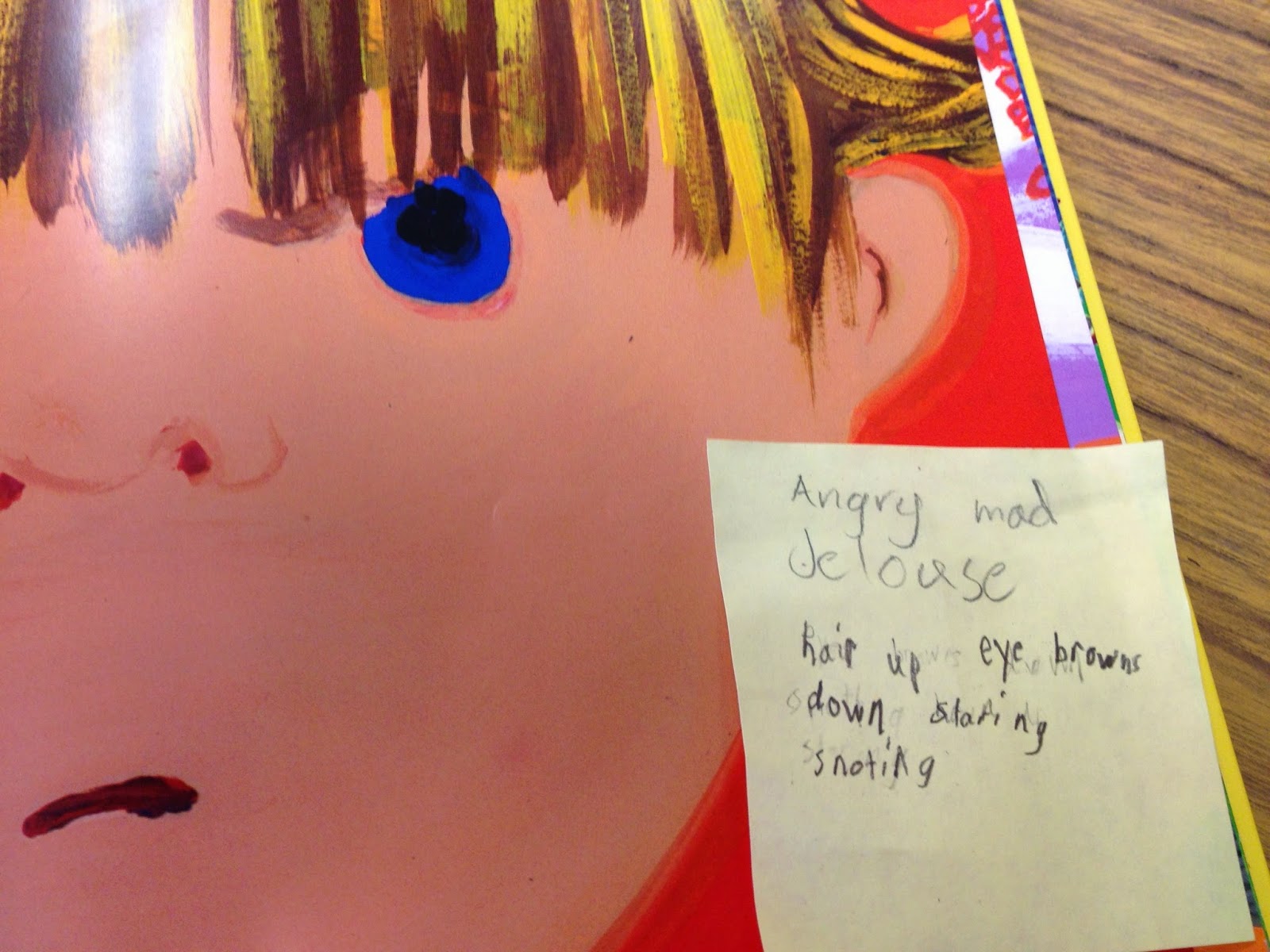
Supporting their opinions with this type of clear details is just the sort of practice that they need when they start writing literary essays. But even more importantly, in my opinion, it helps them read carefully and empathize with characters.

Another pair of 3rd graders loved sharing A Ball for Daisy, by Chris Raschka. Our students worked on developing descriptive words for character's emotions -- not just saying that Daisy was sad, but that she was "depressed, melancholy, unhappy." 
detail from A Ball for Daisy, by Chris Raschka
I just love this example from Mo Willem's Goldilocks and the Three Dinosaurs, where students described the mother dinosaur as "sneaky, tricky and mysterious."
detail from Goldilocks and the Three Dinosaurs, by Mo Willems
Lisa started off her presentation by sharing picture books that make us feel like we're going on a treasure hunt. Kids know Where's Waldo, but books like Benjamin Chaud's wonderful The Bear's Song incorporate this treasure hunt into the essential plot of the story. 

We had great fun looking at Lisa's recent books Vampire Boy's Good Night and Emily's Blue Period, noticing the details she used to add depth and meaning to the story. We had already read these stories before her visit, so students loved showing her the details they had already noticed (the butler has a bandaid on his neck!) and hearing about others that helped us see more into the story.
Lisa Brown shows her sketchbook to students
Finally, Lisa shared her sketchbook--explaining how she draws every day. And she celebrated drawings our students had done, sketching all sorts of emotions and expressions.

Sending out huge thanks to Lisa Brown for taking the time to visit, and to the Berkeley Public School Fund and the Emerson PTA for sponsoring this author visit.If you make a purchase using the Amazon links on this site, a small portion goes to Great Kid Books. Thank you for your support.

©2015 Mary Ann Scheuer, Great Kid Books

Sunday, March 8, 2015

Wangari Maathai: The Woman Who Planted Millions of Trees, by Franck Prévot (ages 7-12)

Wangari Maathai won the Nobel Peace Prize in 2004 for her work helping women throughout Africa planting trees to improve the environment and their quality of life. As we celebrate Women's History Month, I am excited to share this new picture book about her struggles and accomplishments with my students.
Wangari Maathai
The Woman Who Planted Millions of Trees
by Franck Prévot
illustrated by Aurélia Fronty
Charlesbridge, 2015
Your local library
Amazon
ages 7-12
*best new book*
Maathai's political activism shines through in this biography, in her determination to reverse environmental damage caused by large, colonial plantations and empower local villagers--especially women--to improve their local conditions. Prévot begins by introducing young readers to Maathai's legacy:
"It's almost as if Wangari Maathai is still alive, since the trees she planted still grow. Those who care about the earth as Wangari did can almost hear her speaking... Wangari encouraged many village women. She dug holes with them in the red soil--holes in which to plant hope for today and forests for tomorrow."
As Prévot tells Maathai's story, he emphasizes how her childhood and her education shaped Wangari, especially, in a time when very few African women went to school or learned to read.
"When Wangari planted a large-leafed ebony tree or an African tulip tree, she was reminded of her own roots."
This biography allows students to develop a deeper understanding of the political, economic and social structures Maathai stood up against. I love being able to share with students the value of reading more than one book on a subject, seeing how different authors draw out different details. I would start by reading Seeds of Change, by Jen Cullerton Johnson, and watching a short video. If you build background knowledge, students can then dig into statements such as this:
"The government officials who built their fortunes by razing forests try to stop Wangari. Who is this woman who confronts them with a confident voice in a country where women are supposed to listen and lower their eyes in men's presence?"
The illustrations are striking and stylized, lush and vibrant. I especially noticed how Fronty varies the rich, saturated background colors on each spread, adding to the emotions. Just look how bold and strong the red is below--and notice how it contrasts to the cool greens and blues above:
"Wangari believes confident women have an important role to play in their families, their villages, and on the entire African continent."
This is truly an outstanding picture book biography. Prévot finishes with a detailed timeline of Maathai's life, illustrated with several photographs. This background material is both easy to access, written in short chunks, but also detailed to give a rich picture of her struggles and achievements.
From the backmatter -- timeline, informaiton about Kenya today, the damage caused by deforestation
Illustrations ©2011 by Aurelia Fronty; originally published in France. Used with permission from Charlesbridge. The review copy was kindly sent by the publisher. If you make a purchase using the Amazon links on this site, a small portion goes to Great Kid Books. Thank you for your support.

©2015 Mary Ann Scheuer, Great Kid Books

Sunday, March 1, 2015

Juna's Jar, by Jane Bahk and Felicia Hoshino (ages 4-7) -- imagination and friendship soar

I adore picture books for the way they let us escape into our imagination, but they can also help us recognize our resilience (and our children's) as we face disappointment. Share Juna's Jar, a lovely new picture book by debut San Francisco author Jane Bahk, and talk with your children about how Juna's imagination helps her when she misses her friend Hector.
Juna's Jar
by Jane Bahk
illustrated by Felicia Hoshino
Lee & Low, 2015
Your local library
Amazon
ages 4-7
Juna and Hector always loved collecting things together and putting them in Juna's kimchi jar, but Juna is at a loss when Hector moves away. It's especially sad that she hasn't had a chance to say goodbye.
"Juna loved to take the jar and go on adventures with her best friend, Hector."
Her big brother, Minho, helps cheer her up, getting her a fish. That night, Juna dreams of diving into the ocean, swimming with her new fish and looking for Hector. The next night, after her brother gives her a bean plan to fill the jar, she journeys into the rain forest. On the third night, Juna rides a cricket in her dreams, traveling far outside the city to Hector's new home. As she sees him sleeping, Juna is able to whisper goodbye.

Felicia Hoshino's gentle watercolor illustrations capture Juna's wistful emotions, full of longing but also the final promise of new friendship.

I love how friend Margie Myers-Culver sums it up in her review at Librarian's Quest:
Juna's Jar "asks readers to think about friendship, family and the potential of imagination. It's not about looking at life as a glass half full or not but what can happen when we fill the glass."
Jane Bahk won the 2010 Lee & Low New Voices Award for an unpublished author of color, with the manuscript for Juna's Jar. I look forward to more stories from her! I also want to honor and thank Lee & Low for this important award.

The review copy was kindly sent by the publisher, Lee & Low. If you make a purchase using the Amazon links on this site, a small portion goes to Great Kid Books. Thank you for your support.

©2015 Mary Ann Scheuer, Great Kid Books

Wednesday, February 25, 2015

My Three Best Friends and Me, Zulay -- by Cari Best and Vanessa Brantley-Newton (ages 5-9)

With our 3rd graders, we're spending a lot of time looking at how we understand characters' feelings through what authors write and illustrators draw. This helps students understand the layers of a story and connect to characters, but it also helps them develop empathy. Our kids loved reading a new book, My Three Best Friends and Me, Zulay, and really connected to the story. It's truly a special book about perseverance, friendship and blindness.
My Three Best Friends and Me, Zulay
by Cari Best
illustrated by Vanessa Brantley-Newton
Farrar, Straus and Giroux / Macmillan, 2015
Your local library
Amazon
ages 5-9
Adults might first notice the cane that Zulay is holding, but kids first noticed the braille alphabet on the back of the book. After they all felt the back cover, we talked about why Zulay might need to use this alphabet, so everyone started with a little background knowledge. Zulay has a huge smile on her face as she comes to school, arm in arm with her three best friends.
"We link our arms and skip our legs and sing like the stereo till Ms. Perkins, the hall lady, tells us to stop. 'You have a new perfume!' I say, and she says back, 'Zulay doesn't miss a thing.'"
Zulay loves her teacher, writing on her Brailler and helping her friend figure out a math problem. But when Ms. Turner, an aide, comes to help her practice using her "fold-ing hold-ing cold-ing" white cane, Zulay is reluctant. She doesn't want to be left behind or different from everyone else.

We talked about what it means, not wanting to "stick out", and why she might feel like this. I shared how hard it was for me to have to get extra help with my multiplication facts in 3rd grade. Kids talked about the illustration below, and how Zulay was feeling as she struggled learning to use her cane outside. We looked at Zulay's expression and thought about how it would feel.
"Then we practice together in the big outside with no walls or desks or friends." 
Zulay's spirit shines as she decides that she wants to run in the Field Day race around the track. She practices and works hard, and--just like Zulay's friends--my students cheered when she ran the final race.
"'Run, Zulay, run!' my friends all shout, like I shouted for them."
My students could definitely relate to how hard Zulay worked, how worried and uncertain she felt when things were difficult, and how excited she was at the end. The only detail they were a little unclear about is whether Zulay ran with Ms. Turner, as you see above, or by herself as it shows her when she crosses the finish line.

There are very few picture books about showing contemporary kids who are blind, so it is especially refreshing to see one with such a positive character and inclusive message.

This week, kids will look at a big array of picture books finding examples of characters' expressions. We are excited to have a visit by Lisa Brown, picture book illustrator and author, who will talk with 3rd and 4th graders about the Art of the Picture Book. Lisa's characters are full of a wide range of expressions -- just take a look at her Tumblr, where she posts daily sketches.

The review copy was kindly sent by the publisher, Macmillan, and we have already purchased an additional copy for our school. If you make a purchase using the Amazon links on this site, a small portion goes to Great Kid Books. Thank you for your support.

©2015 Mary Ann Scheuer, Great Kid Books

Sunday, February 22, 2015

Last Stop on Market Street, by Matt de la Peña and Christian Robinson (ages 4-8)

Spending time together. A grandmother and her grandson. That love and friendship is what life's all about.

I love how picture books can capture a small moment--and help us hold onto the small moments in our own lives. Matt de la Peña and Christian Robinson's wonderful picture book Last Stop on Market Street makes me smile every single time I read it--it's so filled with love, friendship and an appreciation for life, in such a real way.
Last Stop on Market Street
by Matt de la Peña
illustrated by Christian Robinson
G.P.Putnam's Sons / Penguin, 2015
Your local library
Amazon
ages 4-8
*best new book*
When CJ and his grandmother finish church, they head to the bus stop together. CJ doesn't want to wait for the bus, stand in the rain, or go places after church. "Nana, how come we don't got a car?" Nana gently chides him, really just planting seeds for how she sees the world. "Boy, what do we need a car for? We got a bus that breathes fire and old Mr. Dennis, who always has a trick for you."
"Boy, what do we need a car for? We got a bus that breathes fire and old Mr. Dennis, who always has a trick for you."
You see, it's really how you look at the world, the magic you can see there, and the people you meet along the way. When CJ asks why a man on the bus can't see, Nana tells him, "Boy, what do you know about seeing? Some people watch the world with their ears."
"Some people watch the world with their ears."
CJ's grandmother helps him see beauty in his surroundings, whether it's the bus or the soup kitchen they head to every Sunday afternoon. As Nana said,
"Sometimes when you're surrounded by dirt, C.J., you're a better witness for what's beautiful."
Matt de la Peña and Christian Robinson celebrate the relationship between CJ and his grandmother, and they help all of us see beauty in the small moments, where we never even thought to look. This is a book I look forward to sharing with a wide range of children. Young ones will feel the love between grandmother and grandson; older ones will see the messages that the authors are sharing.

I know my students will especially love the illustrations, with such a wonderful range of people that look so much like the people we see every day walking in our city. The rich, full colors infuse the landscape and city scenes with warmth, community and happiness.

Want to learn more? Check out:
I'm so happy to hear that this special book is now on the New York Times Bestseller list. Hooray! I've already purchased five copies to share with friends. Illustrations from LAST STOP ON MARKET STREET written by Matt de la Peña. Illustrations © 2015 by Christian Robinson. Used with permission from G.P. Putnam's Sons / Penguin. The review copy was kindly sent by the publisher. If you make a purchase using the Amazon links on this site, a small portion goes to Great Kid Books. Thank you for your support.

©2015 Mary Ann Scheuer, Great Kid Books

Wednesday, February 18, 2015

The Case for Loving: The Fight for Interracial Marriage, by Selina Alko & Sean Qualls (ages 4-9)

There are so many different ways into sharing The Case for Loving: The Fight for Interracial Marriage. The story centers around Richard and Mildred Loving, the interracial couple who challenged Virginia's laws forbidding interracial marriages and took their case all the way to the Supreme Court.

You might approach it as a story of two people who stand up and fight for what they think is right--a book about courage, civil rights and fighting for change. Or you might see it as a way to start talking about race with young children, and the struggles one family went through not so long ago. Whichever you choose, this picture book makes a wonderful jumping off point for talking with kids about things that really matter.
The Case for Loving:
The Fight for Interracial Marriage
by Selina Alko
illustrated by Sean Qualls and Selina Alko
Arthur A. Levine / Scholastic, 2015
Your local library
Amazon
ages 4-9
*best new book*
Richard Loving and Mildred Jeter fell in love in 1958, but it was against the law for them to get married in the state of Virginia--simply because they were different races. Although they were married legally in Washington, D.C., the local police arrested and jailed them when they returned to Virginia, charged with "unlawful cohabitation". In order to live together legally and safely, they had to leave their families and move to Washington, D.C.

By 1966, the Lovings decided that "the times were a-changing" and they wanted to return home to Virginia. They hired lawyers to fight for them, taking their case all of the way to the Supreme Court.
The lawyers read a message from Richard: "Tell the court I love my wife, and it is just unfair that I can't live with her in Virginia,"
The Supreme Court unanimously agreed that it was unconstitutional to make marriage a crime because of race, and the Lovings moved back to Virginia to live "happily (and legally!) ever after."

Selina Alko tells this story in a calm, straightforward way, helping children understand how different and difficult things were for interracial couples just 60 years ago. The illustrations show Richard and Mildred's love and strength, but the gentle tones and collaged hearts keep the spirit warm and positive. Alko and Qualls explain the special importance of this story: their journey as an interracial couple echoes the Lovings'. Their endnote adds weight and perspective.

I especially appreciate how this picture book lends a way into opening up an important topic with young children. It helps talk about something that has now changed--but we still wrestle and notice so  many of these issues around us. Here's an excerpt about the importance of opening up dialog about race with children aged 5-8 from The Leadership Council, a civil and human rights coalition:
Five-to eight-year-olds begin to place value judgements on similarities and differences. They often rank the things in their world from "best" to "worst." They like to win and hate to lose. They choose best friends. They get left out of games and clubs, and they exclude others-sometimes because of race, ethnicity, and religion.

When children begin school, their horizons expand and their understanding of the world deepens. We can no longer shelter them quite as effectively. Even for graduates of preschool or day care, attending elementary school means more independence in a less controlled environment. Children are exposed to a wider range of people and ideas. They also experience more bigotry!

Between five and eight, children are old enough to begin to think about social issues and young enough to remain flexible in their beliefs. By the fourth grade, children's racial attitudes start to grow more rigid. Our guidance is especially crucial during this impressionable, turbulent time.
Interesting food for thought, hmmm? To me, this underscores the importance of entering into these discussions with kids, asking what they notice, what they think -- prompting them to think about why and how they can keep their minds open.

For more excellent nonfiction picture books, check out the Nonfiction Picture Book Challenge over at Kid Lit Frenzy. Today, Aly has a great selection of mini-reviews and links to other terrific blogs.

Illustrations from THE CASE FOR LOVING Written by Selina Alko. Illustrations © 2015 by Sean Qualls and Selina Alko. Used with permission from Arthur A. Levine Books / Scholastic. The review copy was kindly sent by the publisher Scholastic. If you make a purchase using the Amazon links on this site, a small portion goes to Great Kid Books. Thank you for your support.

©2015 Mary Ann Scheuer, Great Kid Books