Tuesday, November 4, 2014

Investigating about explorers: a range of resources (ages 8-12)

Do you have fond memories of reading your history textbooks? Probably not. So how can we make history more interesting for our children?

We want our children to envision what it would have been like to live long ago, to make the messy decisions that people had to make, to struggle and wrestle with life, warts and all. And yet we also need to convey basic information about historical periods and figures. How do we balance the facts with the engaging material?

As a case in point, I've been helping 5th grade students gather information about famous explorers from different eras. They're investigating Marco Polo, James Cook, Hernando Cortes, Amelia Earhart, Sally Ride and many others. Their teachers want them to practice note-taking skills. What resources will help them the most?

World Book Encyclopedia: building background knowledge
"How are we supposed to choose which explorer to do our report on if we don't know anything about them?"
Students need to begin their research process by learning some basic facts about their subject. This should be pretty easy for the children to read, since they need to focus on building a clear framework in their minds. I would suggest just reading at this point, not taking notes. We start with World Book Kids, the junior version of the World Book Encyclopedia.

Web Path Express: guided Internet research
"I call this Google for 5th graders."
We have recently added WebPath Express to our Follett Destiny library catalog. This service guides students in their Internet searches, helping them go directly to accurate, age-appropriate sites. Students are able to find reliable resources quickly, without having to filter out commercial or college-level sites.
Explorers
by Chris Oxlade
Kingfisher Readers, level 5
Kingfisher, 2014
Your local library
Amazon
ages 8-10
Students will like the clear sentences and frequent illustrations in this brief introduction to nearly twenty explorers from ancient to modern times. Each explorer's major achievements and struggles are covered in a two-page spread, so the pace moves quickly. Sentences are relatively short, and drawings keep interest high.
"Marco Polo was born in Venice, in Italy. In 1271, when he was just 17 years old, he set off for China with his father and his uncle. They took gifts for Kublai Khan, the powerful ruler of China in the 1200s CE."
This type of book will help students develop a "research report" tone to their own writing. It is factual and straight forward. But it does not have much depth, it does not really prompt students to connect to what they're reading or to ask questions.
Lives of the Explorers:
Discoveries, Disasters (and What the Neighbors Thought)
by Kathleen Krull and Kathryn Hewitt
Houghton Mifflin Harcourt, 2014
Google Books preview
Your local library
Amazon
ages 8-12
Krull engages readers with dynamic writing, as she introduces them to the lives of twenty ancient and modern explorers. While this is more difficult to read, it is also much more interesting. She begins the chapter on Mathew Henson, African American explorer of the North Pole in the early 1900s, this way:
"Matthew Henson and Robert Peary shared many an unappetizing meal in the frozen land around the North Pole. But in the United States they wouldn't have even been allowed to eat together, as restaurants were segregated into 'black' and 'white' sections."
In just three pages, Krull helps readers get a sense of the challenges Henson faced and his remarkable achievements. She incorporates quotes from Henson to give a sense of his perspective. Teachers and librarians should note, however, that she does not indicate the sources for her material, but just provides sources for further reading.
Into the Unknown
How Great Explorers Found Their Way by Land, Sea and Air
by Stewart Ross
illustrated by Stephen Biesty
Candlewick, 2011
Your local library
Amazon
ages 9-14
*my full review here*
Stewart Ross and Stephen Biesty absolutely captivate me each time I read a section of Into the Unknown. Biesty's intricate illustrations draw me right into each scene, helping me imagine what it would be like to be part of an expedition. Students love the fold-out illustrations and the cut-aways that show you the inside of ships. Ross's descriptions include enough detail to engross me without overwhelming me. They have a strong narrative flow, conveying the dramatic pull of these stories but also helping young readers start forming their own questions and conclusions.

The review copy of Explorers came from our public library. The review copy of Lives of the Explorers was kindly sent by the publishers, Houghton Mifflin Harcourt. The review copy of Into the Unknown was kindly sent by the publishers, Candlewick. If you make a purchase using the Amazon links on this site, a small portion goes to Great Kid Books. Thank you for your support.

©2014 Mary Ann Scheuer, Great Kid Books

Sunday, November 2, 2014

The Farmer and the Clown, by Marla Frazee -- listening with our eyes, ears and heart (ages 3-8)

Our world often seems filled with a cacophony of chatter and bickering -- whether it's on the playground or at home. And so I relish the moment when I can slow down to savor a quiet moment with my students. Marla Frazee's newest picture book, The Farmer and the Clown, creates that quiet moment and helps us see the power of friendship.
The Farmer and the Clown
by Marla Frazee
Beach Lane / Simon & Schuster, 2014
Your local library
Amazon
ages 3-8
*best new book*
The book opens as a farmer angrily toils away in solitude. All of a sudden, he's startled as a young clown bounces off a passing circus train. As the farmer brings the little clown home, he looks burdened, exhausted. Just look at the farmer's body language:
from The Farmer and the Clown, by Marla Frazee
As the farmer and clown share time together, you can see the farmer's whole disposition change. I love talking with children about what they notice in picture books. With a wordless book like this, we need to listen with our eyes and our heart--just the way the farmer starts listening to the small child.

Read this book with a child and watch how still they get, how their eyes light up -- especially at the page below when the clown washes off his makeup. And then at the end, the questions I always ask children are:
  • What moment does the farmer start to change? 
  • How can they tell? 
  • What do they notice?

from The Farmer and the Clown, by Marla Frazee
At school, we talk explicitly about how important it is to listen with our whole bodies to someone -- to read their body language as well as to listen to their words. The Toolbox Project describes this as the Listening Tool:
"I listen with my ears, eyes and heart — When I listen as well as hear, I can really understand. When we listen with our ears, our eyes, and our hearts, we become deep listeners who can “hear between the lines.” Our ears bring us the words and intonation; our eyes bring us body language, gestures, and facial expressions; and our hearts bring us empathy—allowing us to walk in someone else’s shoes."
I think this perfectly describes how we can understand the farmer--and why this book engages readers so emotionally--without any words at all. By listening closely, we develop empathy for another person.

Read more about the process Marla Frazee used in creating this beautiful book, one of my favorites of the year, at Seven Impossible Things Before Breakfast -- I loved all the work in progress she shows. I also love the conversation Marla has with Roger Sutton at this Horn Book interview.

Read The Farmer and the Clown with a little person in your life, and enjoy the warmth of the friendship. Read it with an older child and relish the conversation it can start. Or just find a peaceful moment for yourself and savor the beauty of listening with our eyes, ears and heart.

The review copy was purchased for our school library. Illustrations are copyright ©2014 Marla Frazee, used with permission from the publisher Simon & Schuster. If you make a purchase using the Amazon links on this site, a small portion goes to Great Kid Books. Thank you for your support.

©2014 Mary Ann Scheuer, Great Kid Books

Wednesday, October 29, 2014

Firebird, by Misty Copeland and Christopher Myers -- follow your dreams and soar (ages 6-10)

We want to teach our children to follow their dreams, to reach for the stars -- but we also want them to realize that it takes hard work, practice and perseverance to get there. Firebird is a beautiful, stirring new picture book by ballerina Misty Copeland that shares both of these messages, and more.
Firebird
Ballerina Misty Copeland Shows a Young Girl How to Dance Like the Firebird
by Misty Copeland
illustrated by Christopher Myers
G.P. Putnam's / Penguin, 2014
Your local library
Amazon
ages 6-10
*best new book*
As you begin reading this picture book with children, you'll need to take on two voices, for Copeland creates a conversation between a young girl who dreams of dancing and herself as a professional ballerina. The girl looks up to Copeland, saying, "the space between you and me is longer than forever" -- how could I ever become as beautiful and graceful as you?
"you are the sky and clouds and air"
Firebird, by Misty Copeland & Christopher Myers
The real magic begins when Copeland turns to the young girl, reassuring her that she was once just as small, just as shy, that "you're just where I started." Through this poetic conversation, Copeland conveys that this young girl can become a professional dancer if she puts in the hours of work, sweat and practice.
"I was a dancer just like you
a dreaming shooting star of a girl
with work and worlds ahead"
Share this picture book with older students, perhaps 3rd and 4th graders, who can understand Copeland's poetic language and the interplay between the two characters. Encourage them to read this story more than once--it is one that really grew in my heart each time I read it.

Deepen their appreciation for Copeland's message by encouraging them to learn more about her as a professional dancer. Read her afterword, a note to the reader about why she wanted to write this story.
"My hopes are that people will feel empowered to be whatever they want to be... No matter what that dream is, you have the power to make it come true with hard work and dedication, despite what you look like or struggle with."
Students would find this ABC News interview very interesting:


Christopher Myers' artwork brings strength and grace to this story with dramatic lines and colors. The idea for this book was actually Chris's, as Misty told Jules Danielson in a recent Kirkus article. His mixed media collages contrast the bold colors of ballet with the young girl's grey concrete world, but they also juxtapose angular lines with the dancers' dynamic graceful movement.

I can't wait to hear what my students say about this. I think this is a book that they, too, will return to time and time again. The review copy was kindly sent by the publishers, Penguin Random House. Illustrations are copyright ©2014 Christopher Myers. If you make a purchase using the Amazon links on this site, a small portion goes to Great Kid Books. Thank you for your support.

©2014 Mary Ann Scheuer, Great Kid Books

Sunday, October 26, 2014

The Monsterator, by Keith Graves -- and other fiendish delights (ages 5-9)

Do your children want to be something goulishly great on Halloween? Do monsters delight them? There's no doubt that The Monsterator, with its bold promise of 625 monsters inside, will captivate many young readers who dream of something "screamingly scary."
The Monsterator
by Keith Graves
Roaring Brook, 2014
Your local library
Amazon
ages 5-9
*best new book*
Young Master Edgar Dreadbury finds your standard Halloween costumes a terrible bore. "I wish I could be something screamingly scary. / Something fanged and foul and horribly hairy!" Graves draws readers in with rhyming text that is a delight to read aloud, but he really grabs readers when Edgar steps into The Monsterator. All of a sudden, Edgar is completely transformed "from his teeth to his toes."
The Monsterator, by Keith Graves
"When the machine finally quit,
Edgar crashed through the door.
He banged on his chests with his fists
and roared."
The Monsterator, by Keith Graves
I love how Graves strikes just the right balance between frightening and fun for first and second graders. But what they will love most of all is the surprise at the end, when they can "monsterate" young Edgar, by turning a series of flaps to create hundreds of different creatures.

If you like this, you might like some of these other monsterish favorite picture books:
The review copy was kindly sent by the publishers, Macmillan Books. Illustrations of The Monsterator are copyright ©2014 Keith Graves, used with permission of the publisher. If you make a purchase using the Amazon links on this site, a small portion goes to Great Kid Books. Thank you for your support.

©2014 Mary Ann Scheuer, Great Kid Books

Monday, October 20, 2014

Creepy short stories: mysteries & thrillers for ages 10-13

I have never liked horror movies. Never. Ever. But I know that scary, frightening stories have a real appeal for many people. So how do I recommend them for my students? It's a challenge -- especially gauging that right balance between spine-tingling-fright and oh-no-way-too-frightening-for-10-year-olds.

Here are four short-story collections I am recommending to students. Please be warned: if they are too scary, stop reading. That's what I've done in many cases.
Cabinet of Curiosities
36 Tales Brief and Sinister
by Stefan Bachmann, Claire Legrand, Katherine Catmull and Emma Trevayne
HarperCollins, 2014
Podcast + Website
Your local library
Amazon
ages 10-13
Four "curators"--Bachmann, Legrand, Catmull and Trevayne--have gathered together ominous tales, organizing them into different themes ranging from tricks to cake, luck to travel. There are ghost stories, monster stories and bizarre stories. Some have direct villains, while others set a creepy tone without letting you exactly see what's menacing the main character.

The curators have a terrific website Enter the Cabinet with many tales, both ones from the cabinet and others freshly added. My current favorite is The Door Downstairs, with a courageous heroine, eerie setting, and psychological themes. For extra creepy fun, check out the podcasts the curators recorded. Katherine Catmull's recording of "Dark Valentine" is enough to haunt my dreams tonight.

Here are some other favorite collections of frightening stories:
Guys Read: Thriller
edited by Jon Scieszka
Walden Pond / Harper Collins, 2011
Your local library
Amazon
ages 9-12
Jon Scieszka's collection has great kid appeal, with contributions from 10 different superb authors. I loved Matt de la Peña's story "Believing in Brooklyn" about a wish-making-machine, with its creepy coincidences and touching ending. What would you wish for if you could have anything you wanted? If you like this, check out all the Guys Reads collections.
On the Day I Died
Stories from the grave
by Candace Fleming
Schwartz & Wade Books, 2012
Your local library
Amazon
ages 11-14
Fleming begins this collection with a version of "The Vanishing Hitchhiker." In her version, the young teen who picks up the hitchhiker is told to take her shoes to the graveyard where she's buried--and he discovers a crowd of ghosts, all wanting to tell him how they died. Fleming sets her story in White Cemetery, an actual graveyard outside Chicago, and each story takes place during a different time period. She deftly weaves in many pieces of historical details, but these never overwhelm the stories.

I found these stories more frightening--certainly too frightening for 4th graders, and probably more suitable for 6th graders. All of the stories center on how a teenager died, and that aspect really got to me. I haven't shared this collection with students yet, so I can't gauge kids' reactions.
Haunted Houses:
Are You Scared Yet?
by Robert San Souci
Henry Holt, 2010
Your local library
Amazon
ages 10-13
The spider story in this collection, "Webs," scared me so much that I couldn't finish reading this collection. As soon as I say that, kids start clamoring for this collection. Here's what I wrote when I originally read this collection:
In one story, a boy’s family is vacationing in a house that is taken over by spiders. Now, these aren’t your typical garden spiders. They are spiders who want revenge for the damages done to their forest and homes. Danny starts to get worried when he finds the rabbit cage filled with spider webs, and then realizes that the bundles in the corner are the dead rabbits encased in spider webs. The story proceeds to even creepier, as Danny discovers more ways the spiders have wrecked damage on previous owners of the house. Needless to say, every time I walk into a spider’s web now, I jump even higher.
The stories in these collections are NOT for everyone, but I know that many of my students clamor for frightening stories. Do you have any favorite short story collections that you hand your 4th, 5th and 6th graders? How do you judge what's too scary?

The review copy of The Cabinet of Curiosities was kindly sent by the publishers, Greenwillow Books, an imprint of HarperCollins. The review copy of the other collections came from our school library. If you make a purchase using the Amazon links on this site, a small portion goes to Great Kid Books. Thank you for your support.

©2014 Mary Ann Scheuer, Great Kid Books

Thursday, October 16, 2014

Counting the days 'till Halloween: two books to share (ages 3-8)

Young kids love Halloween, but some find scary costumes and stories too frightening. So I'm always on the lookout for books that are a little bit creepy, but are still playful and fun. Two new favorites have lots of kid appeal and throw in practice with counting that's just right for preschoolers and kindergartners.
Ten Orange Pumpkins
A Counting Book
by Stephen Savage
Dial / Penguin, 2013
Your local library
Amazon
ages 3-6
Ten pumpkins start the night neatly stacked outside a farmer's house, but they disappear one by one as they night progresses. Savage combines bold illustrations with rhythmic rhyming text, giving young readers just enough clues so they can figure out what happens to each pumpkin. I especially love his striking use of silhouettes--they are creepy and dramatic, yet also simple and straightforward.

Look how effectively Savage uses the page turn to hook young readers (see the first two pages below). Children will love counting the pumpkins and figuring out where the missing one went. Here's a great example of a book that has so many details in the illustrations that kids can add many layers to the story beyond the text--use this to talk with kids as you read, with prompts like "So what do you notice?" and "Oh, so what happened here?"
"Ten orange pumpkins,
fresh off the vine.
Tonight will be a spooky night."
"Yikes! There are 9."
from Ten Orange Pumpkins, by Stephen Savage
Another new favorite with our kindergarten teachers is Not Very Scary. They love this cumulative story not only for its counting practice, but also for its message. While we all might get a little bit scared at Halloween, it's really just all our friends having fun.
Not Very Scary
by Carol Brendler
illustrated by Greg Pizzoli
Farrar Straus Giroux / Macmillan, 2014
Your local library
Amazon
ages 4-8
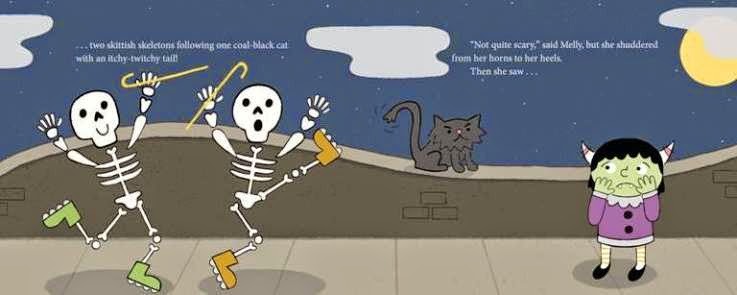
Melly, a cute litte monster, is excited to walk over to her cousin Malberta's house for a Halloween party. Sure it's a gloomy night, but Melly isn't scared--even when she sees "a coal-black cat with an itchy-twitchy tail." She tells herself how brave she is, but readers can tell that she's actually getting scared. Turn the page, and Melly sees "two skittish skeletons" dancing along after the cat.
from Not Very Scary, by Carol Brendler & Greg Pizzoli
Young children know just how Melly feels, getting more and more frightened as each ghoulish creature turns up. This makes the final resolution all the more enjoyable, as Melly realizes that they are all just Malberta's friends coming along to the Halloween party.

Brendler uses wonderfully descriptive language, full of alliteration (grimy goblins, spindly spiders) that makes reading it aloud a joy. Pizzoli's illustrations strike just the right balance, emphasizing the silly fun each creature brings, but never making them too scary. I had a great time reading about his illustration process on his blog and over at his interview at Seven Impossible Things.

The review copy of Not Very Scary was kindly sent by the publishers, Macmillan Books. The review copy of Ten Orange Pumpkins came from our school library. If you make a purchase using the Amazon links on this site, a small portion goes to Great Kid Books. Thank you for your support.

©2014 Mary Ann Scheuer, Great Kid Books