Tuesday, January 31, 2012

There's Going to Be a Baby, by John Burningham and Helen Oxenbury (ages 3-7)

Having a new baby brings change for any family, and it can be a big adjustment for a child who gains that new sibling. As parents’ attention shifts toward the coming baby, the soon-to-be big sister (or brother) wonders what it might mean for her (or him). Will her parents have time for her? Will the baby want to play with her big sister, or just take all of dad’s time?

There's Going to Be a Baby
by John Burningham
illustrated by Helen Oxenbury
MA: Candlewick, 2010
ages 3 - 7
available at your local library, favorite bookstore or on Amazon
Anticipation and imagination. That is the powerful mix at work when a young boy asks his mother, “When is the baby going to come?” As they walk along, she answers in a perfectly reasonable way that it will come in the fall, when it’s ready.

“What will the baby do?” wonders the boy.

 “Maybe when the baby grows up, it will be a chef and work in a restaurant,” suggests his mother.

Hmmm, the little boy isn’t sure that’s a good idea. Turn the page, and the little boy imagines a baby making pancakes, spilling a mess everywhere.

As the young mother suggests straightforward answers, the little boy imagines all the trouble a baby might cause. You’ll laugh at the preschooler’s inventive imagination, but you can also feel his anxiety and uncertainty. Just what will this new baby be like? This sweetly funny book, with its retro feel and muted colors, will bring smiles to parents and children anticipating a new baby.

For more books to share with children about having a new baby, head over to my Bookshelf article for this month at Parents Press. I feature five books that look at this change from a child’s perspective.

The review copy was kindly sent by the publisher, Candlewick Press. If you make a purchase using the Amazon links on this site, a small portion goes to Great Kid Books (at no cost to you!). Thank you for your support.

Review ©2012 Mary Ann Scheuer, Great Kid Books

Sunday, January 29, 2012

How Did That Get In My Lunchbox? by Chris Butterworth (ages 4 - 8)

My kids love cooking, but if you ask them where their food really comes from I'm not sure they'd be able to tell you. Sure, they can tell you that apples grow on trees - but what about bread? cheese? chocolate? How Did That Get in My Lunchbox? takes this question and shares the answers in an engaging, fun way for young children.
How Did That Get in My Lunchbox?
The Story of Food
by Chris Butterworth
illustrated by Lucia Gaggiotti
MA: Candlewick, 2011
ages 4 - 8
2012 NSTA/CBC Outstanding Trade Book
available from your local library, favorite bookstore, or on Amazon
How do we get most of the food we eat? That's right, we make a trip to our nearest store. If we're lucky, we have a home or community garden where we can grow some of our own food. But we are far removed from most food production. Butterworth shows readers how each item in their lunchbox makes it from the farm to the table. For some items like an apple or clementine, it's a simple journey growing on a tree, being picked and washed, then traveling to the store. But other items are much more complicated; bread starts as a grain, which is then ground to flour before it can be baked into bread. Butterworth clearly explains how several items in a typical lunchbox are made, providing enough information to help children envision this but keeping it simple enough for young readers to follow.

This book keeps a fun, fresh tone with Gaggiotti's retro cartoon illustrations. The illustrations will draw young kids in to this factual book and keep their interest. Gaggiotti has integrated the text into the illustrations, making each numbered step clear to follow.

Take a look at this Google preview to get a sense of how fun this would be to share with preschoolers or young elementary school children:


The final two page spread shows the four food groups that should be included in our daily diet and how much space they should take on our plate. I especially liked Butterworth's kid-friendly description of the food groups, such as, "Protein: These are 'bodybuilders' (to help you grow those extra inches)." Throughout, this has an informative but encouraging tone perfect for preschoolers, kindergartners and 1st graders.

Head over to Wendie's Wanderings for Nonfiction Monday to find more wonderful nonfiction to share with your children.

The review copy came from our school library collection. If you make a purchase using the Amazon links on this site, a small portion goes to Great Kid Books (at no cost to you!). Thank you for your support.

Review ©2012 Mary Ann Scheuer, Great Kid Books

Thursday, January 26, 2012

A Ball for Daisy, by Chris Raschka - winner of the 2012 Caldecott Medal (ages 3 - 8)

Our 2nd graders at Emerson have loved thinking about which picture books should win the 2012 Caldecott Medal, participating in a mock Caldecott of our own. Yesterday we read A Ball for Daisy, by Chris Raschka, who was awarded the 2012 Caldecott Medal this past weekend by the American Library Association. This wordless book will appeal to a wide range of children, from young preschoolers on up. Our students responded to the way Raschka expressed so many emotions purely through his paintings.

A Ball for Daisy
by Chris Raschka
NY: Schwartz & Wade / Random House, 2011
ages 3 - 8
available from your local library, favorite bookstore or on Amazon
2012 Caldecott Medal
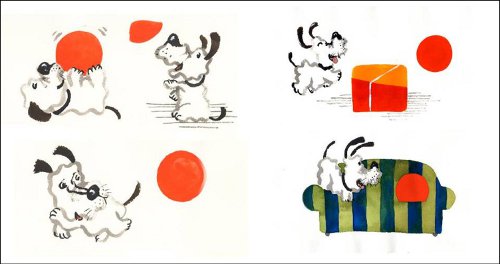
Daisy is a happy, eager little dog who loves her red ball. She leaps and bounds, playing with it at home and then at the park. But one day at the park, another dog starts playing with Daisy's ball. The ball suddenly POPS! and Daisy is despondent. Her owner, a young girl not depicted until half-way through the book, tries to comfort Daisy.

Children respond to Daisy's emotions throughout the story - how excited she is playing with her favorite toy, the despair she feels when she loses that toy. Raschka captures these emotions through Daisy's expressions, movement and posture. We had a great time with 2nd graders looking at Daisy's eyes and practicing different emotions our eyes convey.


The story concludes with another trip to the park, as Daisy and her little girl meet the dog who popped Daisy's ball. This little brown dog and her owner have brought Daisy a new ball, and the book ends with a very happy Daisy cuddling on the couch with her new ball. Our students loved the ending, recognizing that's what you should do if you break a friend's toy. They wondered if Daisy and the brown dog will become friends.

The first time I read A Ball for Daisy I mistakenly thought it was only for young preschoolers. My 2nd graders have shown me, once again, how much they can get from a wordless picture book that explores and celebrates a rich palette of emotions. They appreciated Daisy's emotions, they loved Raschka's use of color and lines, they noticed patterns and details I passed by on my first reading. Picture books, especially wordless ones, let children develop their love of stories, and their understanding of illustrations and visual imagery.

Other reviews can be found in many places, including:
  • A Year of Reading: "brilliant illustrations that tell so much of the story to the reader.  You cannot help but feel what the dog feels throughout the story--all the ups and downs."
  • Waking Brain Cells: "From the bright red of her ball to the striped couch in green, the book embraces color.  Raschka also uses color to convey emotion, which is particularly effective when the air itself is colored with purples and blues after Daisy’s ball is popped."
  • ProseAndKahn: "Daisy is drawn with a minimum of squiggly lines, but her posture and expressions speak volumes. The contrast of moods between the walk to the park and away from it, is striking. Readers will feel pity for the poor lonely dog trying to nap without his favorite toy."
  • NPR interview with Chris Rashka:  Raschka has a simple criterion for choosing his subjects: "Anything that creates a strong emotion in me," he says. "Whether it's music, loss of something, loneliness or friendship — if that emotion is heightened in some way and painted to fit in between the covers of 32 pages, that can become a picture book."
  • Seven Impossible Things Before Breakfast: "I’m a raging fan of Raschka’s minimalist, vigorously-stroked artwork".
The review copy came from our local bookstore Mrs. Dalloway's and our school library. If you make a purchase using the Amazon links on this site, a small portion goes to Great Kid Books (at no cost to you!). Thank you for your support. Review ©2012 Mary Ann Scheuer, Great Kid Books

Monday, January 23, 2012

Connecting with a community of readers

I feel tremendously lucky to be a librarian, to be able to reach out to children and parents helping them find books, stories, information that might just maybe find a home in their hearts and minds, or maybe provide laughter or escape, or maybe a glimpse of who they are or what the world is like.

I have done many different jobs, from helping little old ladies in Kankakee, Illinois figure out their Medicare problems, to analyzing health care reform plans, to teaching eighth grade English. While I did truly love teaching, no job has been as fulfilling as being a school librarian. I connect with so many kids, help all types of readers, see kids' eyes light up when they discover a new favorite book.

Take a moment to tell someone how much you value your local library, your school library, your local bookstore. Maybe tell your child's teacher how much you appreciate their classroom library (chances are they buy many of those books with their own money). Tell your school principal or PTA president how much your library means to you. Tell your neighbors how fantastic your local public library is. Sign this White House petition to “ensure that every child in America has access to an effective school library program.” Find a way to deepen the connection you have to people in your community who value and promote literacy.

But I also feel immensely grateful to have joined a profession with such a supportive community. I am just returning from the American Library Association's Midwinter meeting in Dallas. I had the incredible opportunity to participate in the Bill Morris Seminar to help librarians learn to carefully, thoughtfully evaluate materials for children. We listened to leaders in our field who had chaired Caldecott, Newbery and many other award committees talk about how we identify truly distinguished books for children. We discussed with our peers, other librarians with rich experiences, the strengths and weaknesses of picture books, novels, nonfiction and audiobooks for a wide range of children. We dug deeply into ways to analyze books, continually thinking about how the choices authors, artists and designers make impacts children's experiences with these books.

I want to thank so many people, from the co-chairs of the Morris Seminar, Jenny Brown and Connie Rockman, to my local mentors Kathy Shepler, Linda Perkins, and Nina Lindsay. I want to celebrate my friendships with librarians throughout the U.S.: Cathy Potter, Jill Bellomy, Kim Grad, John Schumacher - just to name a few.

As I sit collecting my thoughts, I am struck by a sense of community: a librarian's role in her community at home, our broader community of readers sharing ideas on the Internet, and the professional community of librarians, authors, publishers. These communities, and our engagement with them, enrich and support all of our lives. And so, yes, I do feel tremendously lucky. Lucky, indeed.

Thursday, January 19, 2012

Me... Jane, by Patrick McDonnell (ages 4 - 8) - inspiring, gentle picture book

Picture books have the power to inspire, entertain and connect us with the larger world. They can help us understand more about the world around us, and they can sometimes help us understand more about ourselves. Me... Jane, by Patrick McDonnell, is a wonderful example of a picture book that resonates with many young children. I read it with our 2nd graders this week as part of our discussion of books that might possibly win the Caldecott Medal next week.
Me... Jane
by Patrick McDonnell
NY: Little, Brown, 2011
ages 4 - 8
available from your local library, favorite bookstore, or on Amazon
2011 Cybils nominee & finalist
winner of the 2012 Charlotte Zolotow Award
Little Jane carries her stuffed chimpanzee Jubilee around with her everywhere - reading stories, exploring outside, climbing trees. Right from the beginning, our students could relate to having a favorite stuffed animal. McDonnell frames this story about the childhood of Jane Goodall, the famous animal behavior scientist, in a way that draws children into connecting with Jane's life. Jane loves exploring the outdoors - and so she spends most of her time either watching animals and plants outside or writing in her journal about facts she's discovered. Our students could easily imagine keeping a journal with questions and observations about the animals around them.

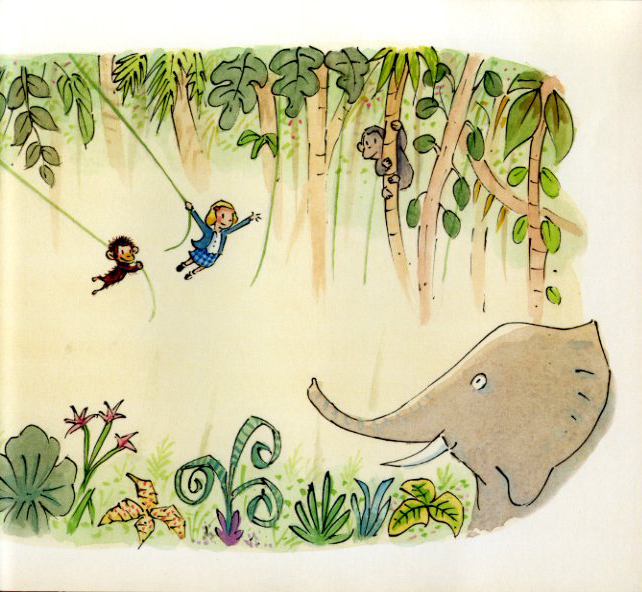
The artwork in this picture book is soft and understated, but with a charming touch. Our students noticed the contrast between the detailed stamps on one side of each spread and the pen and watercolor illustrations on the other side. They liked the way this made them think of real life animals with the intricate engravings, while the illustrations emphasized the child-like quality of the story. My favorite moment of the day was when Anthony raised his hand and said, "I'm making a connection to another book. This reminds me of Where the Wild Things Are." We were looking at the end of the story, when Jane imagines being in the jungles of Africa, swinging from vine to vine with Jubilee swinging behind her. Other students immediately began making connections to the power of imagination that Sendak celebrated in Where the Wild Things Are. It was a wonderful moment that I will always treasure.

The pacing and page turns are masterfully controlled - please read this aloud to your children and ask what they're noticing at each page. The final few turns of the page took our breaths away, in that quiet "ohhhh" type of moment as you realize the scientist that Jane Goodall grew up to be.

This isn't a book a book that will grab you and demand your attention. But if you have a quiet moment, it will plant a seed that may bloom if you give it some time. For another wonderful review, head over to Anita Silvey's Children's Book-a-Day Almanac.

In the end, as we compared Grandpa Green, Blue Chicken and Me... Jane, students each responded differently. I asked them to tell me which book had the best illustrations, since the Caldecott is awarded to the illustrator of the most distinguished picture book. The majority chose Blue Chicken, because they loved the humor in the story and the creative use of color. Others liked Grandpa Green for the detailed illustrations and way it sparked their imaginations. And others definitely chose Me... Jane, for its inspiring story and gentle artwork.

Each year, the Caldecott Committee reviews hundreds and hundreds of picture books - all published in America during that year. The committee meets during the American Library Association's midwinter meeting to discuss the books they find most distinguished, and decide upon a winner. My students and I are very excited to see which book they choose to award the 2012 Caldecott Medal. If you want to watch the announcements live on Monday morning, head over to the ALA site here.

The review copy came from our school library collection. If you make a purchase using the Amazon links on this site, a small portion goes to Great Kid Books (at no cost to you!). Thank you for your support.

Review ©2012 Mary Ann Scheuer, Great Kid Books

Wednesday, January 18, 2012

Brain Burps about Books: fun podcast about children's books

Hey, hey! I had such fun on the radio that I wanted to share MORE about fantastic book apps for kids. I'm joining the BRILLIANT podcast Brain Burps About Books produced by Katie Davis. Hooray! Head on over to Brain Burps About Books to listen to this week's episode where I'll share about the Cinderella app by Nosy Crow.

If you love children's books, either as a parent or librarian -- or as a writer or illustrator, Katie delivers fun, informative interviews with all sorts of folks involved in children's books. This week Katie's interviewing Emma Dryden, a children's book editor with rich and deep experience in the business. Her expertise is "is working with authors to help define, enrich, and craft their work to make it viable for the current marketplace." I can't wait to hear it!

Listen to the show from your computer (Brain Burps About Books) or download the show on iTunes.

I am so excited to share book apps for kids on Katie's show. This week I'm sharing  of Cinderella by Nosy Crow. My students have loved, loved this app. Of course they love the familiar fairy tale, but they're just eating up the interactive features that Nosy Crow has built into this app. I'm very impressed by the thoughtful way that this app creates such a rich layered experience, pulling children back to reading it again and again.

I hope you have fun listening to the episode on Brain Burps About Books, and have a chance to check out the Cinderella app with your kids.

©2012 Mary Ann Scheuer, Great Kid Books