Showing posts with label ages 2 - 4. Show all posts

Wednesday, August 11, 2021

Reading tips & strategies: Playing with the sound of words (ages 2-8)

As your children are getting ready to read or developing their reading skills, it's great to play with the sound of words. Each word is made of small blocks of sounds. In order to learn to read, we need to be able to break words into the smaller parts. Focus on these sounds (not letter names) and play with these sound parts. As Reading Rockets explains:

As the foundation for all written words, letters are important because they are the symbols for the small actions your mouth makes as you say words. What's equally important, however, is that your child learns the sound associated with each letter. These individual sounds are called phonemes, and children who know about the connection between a letter and its phoneme have an easier time learning to read.

Parents can help children get ready to read by playing with the sound of words. Play some of these silly games as you're at the store or cooking dinner. 

image from PBS Kids for Parents

Play with rhymes:
Rhyming games help children recognize how parts of words can be similar. You can sing songs or read stories with rhymes. But you can also play guessing games with everyday objects. Maybe it's a version of "I spy" using rhyming: "I spy something that rhymes with bear.

Be silly with nonsense words: Kids love-love-love being silly. Encourage this, and use nonsense words that play with small sounds of words. These types of words help kids learn to blend together words, using these sound chunks. Maybe if you sneeze, try saying "achoo-a-boo-boo-boo!" Do you see how that helps emphasize that small part of the word?

Listen for sounds: Help your child listen for beginning sounds in words and then play with them. Can they make this even sillier: Silly Sally sings songs all Saturday -- by extending all the sss's? What about Mommy makes mud pies? This sort of goofy playing actually helps children realize that the beginning sounds are important parts of words.

Swap sounds around: For a more advanced game, try removing or swapping sounds. What is ‘beat’ when you take away the T sound? Bee! Maybe they can use this to make up silly nicknames for their pets or stuffed animals.

Read more ideas on PBS Parents at How to Start Playing On-the-Go Literacy Games.

Playing with language and words will help children develop their confidence and phonics skills. How do you help grow your readers? Send me a note, and let me know what works for you! 

©2021 Mary Ann Scheuer, Great Kid Books

Monday, August 9, 2021

New beginnings: 5 books about feeling nervous about the start of school

As summer ends and the new school year begins, it's important to recognize just how big this transition is for kids (and families, too!). So many feelings come with these transitions, no matter how old we are. Share these 5 books, name some of the feelings the characters are going through, and talk about how they're coping. 

Becoming Vanessa, by Vanessa Brantley-Newton: Vanessa is nervous about her first day of school, and plans the perfect outfit -- feather boa, tutu, shiny shoes, her special hat. But frustration takes over when other kids don't appreciate her special outfit and writing her name is hard work. I especially appreciate the way Vanessa discovers the special meaning of her name and realizes that how she feels inside will make her shine.

El Cucuy Is Scared, Too!, by Donna Barba Higher: Ramón can’t sleep -- everything is different in his new house. He is nervous for his first day at a new school. It turns out that El Cucuy, the monster who lives in Ramón’s cactus pot, is scared, too! Kids will laugh at the way Ramón and El Cucuy remind each other about how strong and brave they are, defusing their fears. El Cucuy is a scary Mexican legend, but portrayed here in a cute way to encourage laughs alongside the shivers.

The Day You Begin, by Jacqueline Woodson: "What did you do last summer?" can be a loaded question. As children share about summer travels, Angelina remembers the days spent at home caring for her little sister, and feels very alone at school. In this gentle, beautiful story, Woodson speaks directly to readers, encouraging all of us to find friends who will listen to our stories, a new friend who "has something a little like you--and something else so fabulously not quite like you at all." 

My First Day, by Phùng Nguyên Quang and Huy'nh Kim Liên: A young Vietnamese boy sets out alone in a wooden boat across the Mekong Delta, heading to his first day of school. Captivating illustrations and beautiful, poetic language will make this a delight to read aloud. I especially appreciate the metaphors that encourage readers to see how similar our feelings can be, even though our experiences may be vastly different.

School's First Day of School, by Adam Rex and Christian Robinson: Have you ever stopped to think if the school might be nervous about the new year? Even though Janitor says, “Don’t worry--you’ll like the children,” school does worry. Young readers will appreciate the way this picture book brings a fresh angle to the familiar story, sharing warmth and empathy, and helping all of us consider a new perspective. 
The review copies came from both my public library and from Penguin Random House Publishers. If you make a purchase using the Amazon links on this site, a small portion goes to Great Kid Books. Thank you for your support. 

©2021 Mary Ann Scheuer, Great Kid Books

Sunday, August 1, 2021

Blue Floats Away: Growing up is full of surprises (ages 3-7)

Growing up is full of surprises, and how you see it depends on your perspective. Want to engage in a lively discussion? Ask a group of 4 year olds what makes them big kids, compared to the babies and toddlers in their lives. Not only are they bigger, they also can do many things all by themselves. This growth is exciting, but it also can come with frightening changes. Blue Floats Away captures these feelings, and shares a lesson on the water cycle too.


Blue Floats Away
by Travis Jonkers
illustrated by Grant Snider
Abrams, 2021
Amazon / your local library
ages 3-7 

Little Blue is an iceberg, happily attached to his parents -- and yet, one day, "Blue was suddenly on his own, floating away," unsure if he'll ever return. As Blue floats into his new life, he discovers new and beautiful things. Soon, though, Blue realizes that he's changing -- and the reader sees Blue melting and then turning into a cloud. Blue does make it home, but he's transformed into something new. The author's note explains about how the water cycle works, helping young readers see the science underpinning this story.

As we head back to school, many kids are going to be nervous about the separation and growth they're experiencing, especially if they're heading to a new school. Travis Jonkers captures the full range of emotions young kids go through as they wrestle with these changes. I especially appreciate how we can read this story in so many different ways -- on an emotional level, as a lesson about the water cycle, or as an introduction to global warming. The spare text and bold colors will make this captivating as a read aloud.

My oldest daughter struggled with separation anxiety in preschool (lots of tears) -- and yet she's now happily living across the country! Enjoy your little ones while you can. They do grow up so fast. The review copies came from my public library. As an Amazon Associate I earn from qualifying purchases if you make a purchase using the Amazon links on this site. 

©2021 Mary Ann Scheuer, Great Kid Books

Sunday, July 25, 2021

Wonder Walkers & If You Come to Earth: Inspiring a sense of wonder about our world (ages 4-8)

Are you looking to inspire a sense of wonder about the world around us, tapping into children's innate sense of wonder? Two new picture books lead to wonderful musings about our world: Wonder Walkers, by Micha Archer, and If You Come to Earth, by Sophie Blackall. Both of these let you get away from your everyday world, and look with fresh eyes on everything around us.


Wonder Walkers
by Micha Archer
Nancy Paulsen Books/ Penguin Random House, 2021
Amazon / Your local library
ages 4-8

As two children head outside for a "wonder walk," they ask each other questions about the world around them, making connections to their own experiences. Together, readers will ponder with this pair questions such as: “Is the sun the world’s light bulb?” “Are trees the sky’s legs?” “Is dirt the world’s skin?” “Is the wind the world breathing?” Revel in the vibrant illustrations, and maybe venture out on your own wonder walk. 

"Do mountains have bones? Are forests the mountain's fur?"

I especially appreciate Archer's spare poetic language, letting readers (young and old) sit with these deep questions. This will make a lovely bedtime book, to end the day wondering about the world around us. Teachers can also use it as a springboard for exploring the power of personification, analogies and other literary devices. But really, it just makes me want take a walk with a young person and see what they notice in our world.

If You Come to Earth
by Sophie Blackall
Chronicle Books, 2021
Amazon / Your local library
ages 4-8

"If you come to Earth, there are a few things you need to know..." and so begins the young narrator's musings about how to describe our world to an alien from outer space. And yet, how do we really describe our whole world to someone? How do we capture all the different places in it, all the different ways people live and what they do every day? Quinn, the young narrator, writes of the great diversity of life on Earth. I especially love the detail in each page -- you'll spend time exploring faces full of expression, families of all shapes and sizes picnicking together, of children in class together and adults getting ready for work. 

"We live in all kinds of homes."

Blackall truly celebrates the diversity in our world, making each reader feel part of this special book. Spend time looking closely at all the different homes people make for themselves. Talk gently about what it means not to have a home. Blackall doesn't ignore difficult things in our world, but gently acknowledges that they are part of life too. 

I hope you enjoy spending time with these wonder-inspiring picture books. The review copies came from my public library. As an Amazon Associate I earn from qualifying purchases if you make a purchase using the Amazon links on this site. 

©2021 Mary Ann Scheuer, Great Kid Books 

Sunday, September 8, 2019

Just Ask! Be Different, Be Brave, Be You -- by Sonia Sotomayor (ages 4-10)

With positive energy and affirmation of kids' identities, questions and curiosity, Supreme Court Justice Sonia Sotomayor encourages readers to accept people's differences and disabilities in her wonderful new picture book, Just Ask!
Just Ask! Be Different, Be Brave, Be You
by Sonia Sotomayor
illustrated by Rafael López
Philomel / Penguin; 2019
Google Books preview
Amazon / your local library
ages 4-10
Beginning with a personal letter to readers, Sotomayor explains that she was diagnosed with diabetes at the age of 7, and how she sometimes felt different because of that. Every day she gives herself a shot of insulin, the medicine she needs to stay healthy. Other kids were curious, but they never asked her about it. And yet, if we can ask why someone is doing something different, we can understand each other more fully and appreciate our differences.

Young Sonia and 11 friends gather together to plant a garden, celebrating the magical diversity of plants. Each child introduces their own disabilities and chronic illnesses—ranging from diabetes to deafness—explaining how this is part of who they are and how they do things. As each finishes, they turn to the reader to ask a question, like "Do you use a tool to help your body?" or "How do you use your senses?"

I especially appreciate how each child speaks for themselves, explaining what makes them unique and how they want to be understood.
"For me listening comes more easily than talking--and I'm a really good listener. My  name is Anh and I speak with a stutter, so I sometimes repeat a word or get stuck when I try to say it. It may take me a little longer to express myself, and sometimes I'm too shy to talk, but I understand everything that's going on. Do you ever wonder if people understand you?"
As Sotomayor told NPR, she hopes that readers can understand that our differences make us each special and interesting. "I want every child to understand that whatever condition they bear in life, they are special in a good way."

This affirming book will make a lovely read-aloud for families and classrooms, encouraging children to think about our differences, what makes us special, and how important it is to learn about each other.

The review copy was kindly sent by the publishers, Philomel / Penguin. As an Amazon Associate I earn from qualifying purchases if you make a purchase using the Amazon links on this site.

©2019 Mary Ann Scheuer, Great Kid Books

Sunday, March 17, 2019

In the Middle of the Night: An interview with Laura Purdie Salas about her writing process (ages 3-8)

I'm delighted to celebrate a new poetry book In the Middle of the Night: Poems from a Wide-Awake House, by Laura Purdie Salas. This delightful collection of poems captured my imagination as they describe the adventures of everyday inanimate objects found at night.
In the Middle of the Night: Poems from a Wide-Awake House
by Laura Purdie Salas
Wordsong / Highlights, 2019
Amazon / your local library
ages 3-8
As part of the blog tour celebrating her new book, Laura was kind enough to share about her writing process with me.

Mary Ann: I'd love to share with readers a little bit about your writing process.

Laura: Thanks so much for being part of the blog tour! Unless I’m writing while traveling, I write on my laptop. I might write individual poems on napkins or my phone, but with a big project like a poetry collection, I do less of that. I write most freely when my fingers can move fast, and I can type much faster than I can write longhand. On July 24, 2012, I wrote in my journal:
I spent 30 minutes, finally, on Nobody's Looking (my original name for this idea) last night right before bed. I don't know why I keep procrastinating. Maybe because I don't have a super-clear image of the finished project in my head.
Mary Ann: I can relate to that so much! Procrastination is really difficult to deal with. What did you do when you felt stuck?

Laura: One thing that helped me was reading lots of poetry books I love, that were in a style I was trying to capture. That day, I wrote this blog post about using mentor texts: Finding My Writing GPS. Reading these books gave me a new sense of enthusiasm.
"Animals on the Go"
Mary Ann: I love your use of words. "Lion flips. / Monkey snips. Dolphin drums. / Dragon strums." Your poems are so much fun to read aloud as each word takes shape first on my tongue and then in our minds. How do you gather words for a poem?

Laura: I collect words on a project by project basis. For example, for a draft of a project I'm currently working on, I wrote in my journal:
Also want to brainstorm some words, synonyms and phrases for belonging, accepted, trust, valued...things like that. Not to mention, just...good. Enough.

belong, fit, like a puzzle piece, believed, traditional, standard, agreed, shouldered, believed, faith, belief, hope, rely, trust, expect, care, protect, guard, depend on, count on, be sure about, worth, price, cost, importance.
Those are all just synonyms, but I often make lists of specifically juicy words I come across in my research that I think, Oooh, I want to use that word somehow in my draft.

Mary Ann: Our students and teachers use a word wall. Do you have a word wall at home? What is your writing space like?

Laura: I love so many words. If I had a word wall, I think our townhome would sag under the weight of it! I love walking while I write, so this is my writing space:
Laura Purdie Salas walking and writing
Mary Ann: I love the way stuffed animals come to life in this! Do you have a story about a stuffie from her own childhood?

Laura: What a great question. I have hardly anything from my childhood. Six or seven books, about a dozen photos, and no toys. But I do have Tommy the Turtle. I may originally have “borrowed” him from my big sister, Patty (don’t tell). He has come with me everywhere I’ve ever lived, and I think Tommy would love to have Octopus teach him how to skate!
Laura Purdie Salas and Tommy the Turtle
Thank you so much, Laura! Many congratulations on a wonderful book. Here are all of the stops on the blog tour:
The review copy was kindly sent by the publishers, Highlights Press. As an Amazon Associate I earn from qualifying purchases if you make a purchase using the Amazon links on this site.

©2019 Mary Ann Scheuer, Great Kid Books

Sunday, December 16, 2018

Ten favorite picture books (ages 3-10)

Picture books are truly for everybody. Read them together with young children, sharing a story together, savoring the joy of discovery. Encourage older children to take a break with picture books and savor the story. Here's a selection of old and new picture books I love.

Alma and How She Got Her Name, by Juana Martinez-Neal: Oh how I love this book. As one young reader told me, “it makes me want to learn more about my own name.” Alma helps us all feel like we are special for being unique. Alma Sofia Esperanza Josi Pura Candela worries about her long name until her father tells her family stories, one for each person she's named after. The illustrations are soft and gently sweet, showing the distinctive essence of each ancestor and the affections between Alma and her family. (ages 4-8)

Drawn Together, by Minh Lê, illustrated by Dan Santat: When a young boy visits his grandfather, they struggle to communicate because the grandson only speaks English and his grandfather only speaks Thai. After an uncomfortable dinner where the cultural divides are palpably painful, the boy pulls out a sketch he's made of a superhero. He's surprised when his grandfather starts drawing a Thai warrior. As they start drawing together, they build a new world layered and complex with both cultures. Not only is this a beautiful story, it is full of universal emotions: connecting across generations and cultures, relating to each other through art and storytelling, and discovering shared passions. (ages 4-9)

Duck! Rabbit!, by Amy Krouse Rosenthal, illustrated by Tom Lichtenheld: Is it a duck? Or a rabbit? What do you think? Turn it upside down - do you see anything different? The off-stage narrators argue back and forth, trying to convince each other that their perspective is right. Lichtenheld's illustrations, with absolute clearness and utter ambiguity, are perfect for encouraging your own kids to join the debate. (ages 4-9)

Firebird, by Misty Copeland, illustrated by Christopher Myers: A young African American girl looks up to Copeland saying, "the space between you and me is longer than forever"--how could I ever become as beautiful and graceful as you? Copeland turns to the young girl, reassuring her that she was once just as small, just as shy--and the magic comes when you pursue your dreams. (ages 6-10)

Harold and the Purple Crayon, by Crockett Johnson: One night, Harold decided to go for a walk. Bringing only his giant purple crayon, Harold draws himself a world full of wonder and imagination, from a sailboat on a stormy sea to a picnic with a moose with nine kinds of pie! This classic picture book has inspired young children since 1955, but it captivates children still, showing them how far their imagination can take them. (ages 3-7)

Hello Hello, by Brendan Wenzel: This picture book will delight young readers, saying hello to different animals. Read the spare rhymes slowly, encouraging readers to notice how the animals are similar and different. "Hello Stripes. Hello Spots." Sure, tigers have stripes and cheetahs have spots, but what about fish and lizards? Which they have stripes and spots, too! I especially love the way Wenzel gives clues on each page of what's coming next--the whale shark's spotted tail, leads into: "Hello Giant. Hello Not." Wenzel's animals are full of life, and a key in the back will help eager readers to learn all of their names. (ages 3-8)

Julián Is a Mermaid, by Jessica Love: After Julián, a young Afro-Latinx child, sees three fabulous people dressed as mermaids, he creates his own costume. When Abuela discovers this, will she support him or chastise him? In this delightful story, Julian's grandmother embraces his creativity, helping him complete the outfit, and then proudly taking him to a parade. This story delights readers and never becomes too preachy, staying rooted in the joy of imagination and the importance of being seen and recognized. (ages 4-8)

Niño Wrestles the World, by Yuyi Morales: With a huge imagination and a love of luche libre, the popular Mexican wrestling sport, little Niño battles his own make-believe monsters. Whether he’s defeating the Guanajuato mummy or exploding the giant Olmec Head, this is one confident little kid. Morales brings humor, dynamic energy and vivid artwork to this terrific picture book. (ages 4-8)

Press Here, Hervé Tullet: This ingenious interactive book invites readers right into the action of this story, pressing dots to multiply them, blowing on them to scatter them across the page, clapping to make them blow up like a balloon. It is utterly simple and yet completely engrossing, showing readers that they are truly part of making any story come alive and leap off the pages of a book. (ages 3-7)

Rain, by Linda Ashman, illustrated by Christian Robinson: Have you ever noticed that a good mood can be contagious? One a rain day, a grumpy old man complains about his "nasty galoshes" and the "dang puddle." But not everyone feels that way. A little boy is so excited to put on his froggy hat and rain boots. When they bump into each other, the little guy's mood eventually rubs off on the old man. A delightful story, perfect for spreading a smile. (ages 4-8)

If you make a purchase using the Amazon links on this site, a small portion goes to Great Kid Books. Thank you for your support.

©2018 Mary Ann Scheuer, Great Kid Books

Monday, September 24, 2018

Celebrating the Harvest Moon with two beautiful picture books (ages 3-8)

Cultures around the world celebrate the harvest every autumn, and many involve tribute to the glorious harvest moon. Two of my favorite new picture books honor both the magic of the moon and the importance of family. Both books connect to Asian traditions, and they also reflect North American families celebrating both their American and Asian identities.
A Big Mooncake for Little Star
by Grace Lin
Little Brown, 2018
Amazon / Your local library / Book chat with Grace Lin
ages 3-8
*best new book*
Little Star and her mother bake an enormous mooncake, sharing the joy of baking together. Mama tells Little Star she mustn't eat any yet. Little Star does her best and goes to bed, but when she wakes up in the middle of the night it's just too hard to resist a tiny nibble.
Would her mama notice if she took a tiny nibble? Little Star didn't think so. Mmmm, yum!
As each night passes, Little Star wakes in the middle of the night thinking only of the Big Mooncake. Just one more little bite, and she'll race back to bed. Young readers will smile as the mooncake slowly disappears, recognizing the phases of the moon.
"Night after night,
Little Star took tiny nibble
after tiny nibble
of the Big Mooncake."
Grace Lin creates a story filled with delight and love. In her author's note, she describes how this story celebrates the Chinese Mid-Autumn Moon Festival, yet she is creating a new story here, one that reflects her experience as a mother.

I especially appreciate her video book chat, in which she describes the importance of using her work to explore the American side of her identity. I hadn't noticed the explicit nods to Blueberries for Sal before Lin pointed them out, but I certainly felt kinship toward this mother-daughter delighting in baking together.

Ocean Meets Sky, the beautiful, dreamlike new picture book from The Fan Brothers, also blends Asian and North American storytelling heritage. You'll notice nods to Sendak, Peter Pan and more.
Ocean Meets Sky
by Eric Fan and Terry Fan
Simon & Schuster, 2018
Amazon / Your local library / preview art
ages 4-8
*best new book*
In honor of his grandfather who has passed away, young Finn builds a boat for the journey they always wanted to take. Finn then crawls inside to sleep and dreams of a "great golden fish" who takes him on a journey, in search of the magical land of his grandfather’s stories.
"Finn remembered Grandpa's voice
Telling him stories about a place far away where ocean meets sky."
Finn follows the golden fish into his dreamlike world, searching for where the ocean meets the sky. He sees wondrous scenes, with whales swimming among the stars, bookish birds roosting on the Library Islands, and moon jellies dancing in the sea.
"'I didn't think the open sea would feel so lonely,'
Finn said after some time.
This caught the attention of a great golden fish."
Soon Finn's boat lifts out of the water and sails into the night sky, drifting toward the great full moon. As the golden fish swims toward the moon, readers realize that his grandfather's spirit fills both the wise fish and the luminous moon.

Filled with atmospheric blend of Asian imagery and dreamlike fantasy worlds, this beautiful, magical picture book immerses readers into a young boy’s search for healing.

It strikes me how central storytelling is to both of these picture books, as a way for families to connect and pass down their heritage. In both, building and baking serve as a way for generations to connect, to share time and to create something together. My friends, please seek out these truly special books and share them with your families.

Illustrations copyright ©2018 Grace Lin and ©2018 Terry Fan & Eric Fan, shared by permission of the publishers. The review copies were kindly sent by the publishers, Little Brown and Simon & Schuster. If you make a purchase using the Amazon links on this site, a small portion goes to Great Kid Books. Thank you for your support.

©2018 Mary Ann Scheuer, Great Kid Books

Wednesday, August 29, 2018

Pipsqueaks, Slowpokes, and Stinkers : Celebrating animal underdogs, by Melissa Stewart (ages 4-8)

Young readers delight in learning about new animals. If you have animal lovers in your house or classroom, definitely seek out Melissa Stewart's newest picture book: Pipsqueaks, Slowpokes, and Stinkers: Celebrating animal underdogs. She takes a fresh look at what makes an animal noteworthy--do we really want to focus only on the fastest animals? Or do we want to find out how animals survive and thrive?
Pipsqueaks, Slowpokes, and Stinkers: Celebrating animal underdogs
by Melissa Stewart, illustrated by Stephanie Laberis
Peachtree, 2018
Amazon / Public library / Teachers guide
ages 4-8
Stewart's lively, playful voice draws readers right into her text. We start off looking at a pair of tiny critters, the Etruscan pygmy shrew and the Amau frog. I appreciate how Stewart and Laberis help readers envision just how small these animals are by comparing them to everyday objects.
"Let's start with this little critter--the Etruscan pygmy shrew.
It's a real pipsqueak. Look, it's name is longer than its body."
But the real question, as Stewart asks, is "How can these puny peewees survive?" Turn the page, and readers will see dramatic examples of how being tiny can actually help you hide from predators.
"Believe it or not,
size is on their side."
Stewart presents an engaging look at a range of animals, helping young children think about what characteristics might help animals survive. The backmatter includes more information, but she keeps it quite brief. Instead, she focuses on encouraging children to think about different animals. This would be a terrific discussion-starter for talking about habitats and animal characteristics.

I especially appreciate the gentle message Stewart provides throughout, that every animal has “its own special way of surviving" and we need to recognize the strengths each has just the way they are. Take special note of the dedication at the end of the book:
"For any child who is being bullied right now---
what others see as a weakness may actually be your strength.

Don’t give up."
I have long admired Melissa Stewart's nonfiction books for children and appreciated her thoughtful writing about the craft of writing nonfiction. She helpfully examines different types of nonfiction writing (see her recent article Understanding—and Teaching—the Five Kinds of Nonfiction, published in the School Library Journal). I encourage you to explore her helpful blog, Celebrate Science.

Illustrations copyright ©2018 Stephanie Laberis, shared by permission of the publisher. The review copy was kindly sent by the publisher, Peachtree Publishers. If you make a purchase using the Amazon links on this site, a small portion goes to Great Kid Books. Thank you for your support.

©2018 Mary Ann Scheuer, Great Kid Books

Sunday, August 19, 2018

We Don't Eat Our Classmates, by Ryan T. Higgins -- back-to-school fun, with a dollop of empathy (ages 4-8)

Each fall brings a bevy of back-to-school books--helping young children get used to new classrooms, make new friends, learn new routines. Earnest advice might appeal to parents, but kids love stories combine humor, empathy and advice. If you're looking for a heartfelt back-to-school book, check out We Don't Eat Our Classmates by Ryan T. Higgins.
We Don't Eat Our Classmates
by Ryan T. Higgins
Disney-Hyperion, 2018
Amazon / Public library
ages 4-8
As the first day of school approaches, Penelope worries about making friends. The cuddly cute little T. Rex wonders what her classmates are going to be like, whether they will be nice.

When the first day arrives, Penelope "was very surprised to find out that all of her classmates were... CHILDREN!"

Penelope is so surprised, she ate all the children. "Because children are delicious." The teacher is not impressed, and instructs Penelope to spit them out immediately. Penelope's classmates are covered in slimy spit--you can imagine the giggles that will erupt from young readers.

Phe tries really hard at school, but she keeps eating her classmates. After this, Penelope's classmates don't want to be her friends. They're worried about sitting next to her at lunch.
"It was lonely."
Penelope can't understand why her classmates are reluctant to play with her. It isn't until a goldfish chomps on her finger that she understands just how much this can hurt. When she changes her ways, Penelope starts making friends.

Young students know just how difficult it is to control themselves. Higgins creates a very likable main character--readers will identify with her fears, worries and lack of self-control. With gentle humor, Higgins reminds us to think about how your actions might impact others.
"Now, even when children look especially delicious, she peeks at Walter (the goldfish) and remembers what it's like when someone tries to eat you."
Ryan T. Higgins is the author of one of our favorite read-alouds: Mother Bruce. He is a masterful storyteller, knowing just how humor can help resolve important issues. I appreciated reading this interview on Publisher's Weekly about his process creating this story.

Check out more back-to-school favorites on my Goodreads shelf. Illustrations copyright ©2018 Ryan T. Higgins, shared by permission of the publisher. The review copy was kindly sent by the publisher, Disney Hyperion Books. If you make a purchase using the Amazon links on this site, a small portion goes to Great Kid Books. Thank you for your support.

©2018 Mary Ann Scheuer, Great Kid Books

Wednesday, August 15, 2018

Stop, Go, Yes, No!: A Story of Opposites by Mike Twohy -- terrific fun for youngest readers (ages 3-6)

As a school librarian, I delight in sharing books that make kids laugh and want to read more. Stop, Go, Yes, No! is just this sort of book -- our youngest kids will love reading this together again and again. It's funny, full of energy and utterly relatable. The icing on top is that it helps little ones learn about opposites and develop early reading skills.
Stop, Go, Yes, No! -- A Story of Opposites
by Mike Twohy
Balzer + Bray / HarperCollins, 2018
Amazon / Public library / preview
ages 3-6
*best new book*
A grey cat peacefully sleeps on the opening page, and the word "Asleep" is written in large, clear letters. Turn the page, and the joyful dog from the cover shouts "Awake!" jolting the cat from its nap.
Twohy keeps a steady rhythm of paired opposites, as the dog chases the cat and tries to convince it to play. Happy-go-lucky dog just wants to play, but the cat clearly wants to be left alone.
With just 28 words, Twohy builds a story that pulls readers in, makes them laugh and want to find out what happens next.
I appreciate the way Twohy keeps plenty of space around each word, encouraging young readers to look at the picture and then the word. Using these picture clues is an important part of reading development.

Twohy masterfully creates two distinct characters. Try asking young readers how the cat and dog are feeling at different moments. Then have fun role-playing these two characters, or making up your own pairs of opposites. Also be sure to check out Oops, Pounce, Quick, Run! Twohy's previous book with this lovable dog.

Illustrations copyright ©2018 Mike Twohy, shared by permission of the publisher. The review copy was kindly sent by the publisher, Balzer + Bray / HarperCollins. If you make a purchase using the Amazon links on this site, a small portion goes to Great Kid Books. Thank you for your support.

©2018 Mary Ann Scheuer, Great Kid Books

Sunday, April 15, 2018

Mommy's Khimar, by Jamilah Thompkins-Bigelow and Ebony Glenn -- full of love, sunshine and imagination (ages 4-8)

Mommy's Khimar is a delightful new picture book that is full of love, sunshine and imagination. A young Muslim girl plays dress up with her mother's khimar, or Islamic headscarf. When she wraps it around herself, she feels her mother's love surrounding her and she imagines all of the things she can be. The bright, warm illustrations convey all of this love and draw young readers to this story.
Mommy's Khimar
by Jamilah Thompkins-Bigelow and Ebony Glenn
Salaam Reads / Simon Schuster Books for Young Readers, 2018
Amazon / your local library
ages 4-8
*best new book*
I especially appreciate how this picture book is both specific to this young girl's African American Muslim culture and universal. Many of my students will recognize themselves in this story. Some wear a headscarf every day and will see their family's love and heritage in this story. Others will recognize the joy in playing with their mother's clothes.
Jamilah Thompkins-Bigelow
I am honored to have Jamilah Thompkins-Bigelow as my guest here today. My questions are in red below, followed by her answers.

What planted the seeds for writing Mommy's Khimar?
Wearing a khimar or an Islamic headscarf is part of my everyday life but I wasn’t really sure that I wanted to focus on that in writing kidlit with Muslim characters. I remember thinking people always make this piece of cloth so serious but as a kid I didn’t really see it that way. Khimars were soft, silky scarves I borrowed from my mother when it was time to pray or wrapped around myself to create pretend dresses and gowns. So, I guess I ended up telling a story about how four-year-old me saw the khimar.
"A khimar is a flowing scarf that my mommy wears."
What ran through your head the first time you saw the delightful illustrations by Ebony Glenn?
I was just so giddy! I loved the main character’s facial expressions. She’s very adorable. The scene when she is playing in the closet with all of the khimars is magical every time I look at it. And--this may sound strange--but I loved that the characters have dark skin. In the rare stories about Muslims, I rarely if ever see Black Muslims depicted. It was nice to have more diversity.
"Some have tassels. Some have beads.
Some have sparkly things all over."
I'd love to learn more about why you wear a khimar. Can you tell me a little about this tradition and what it means to you?
I was 14 years old when I decided to wear full hijab. Full hijab is the khimar/head covering and clothing that covers everything except the face and hands. I started exploring my faith more around that time and I saw this as a way to demonstrate my faith in God. I also liked and continue to like the way it identifies me as Muslim. Although I am a religious minority, I get to feel connected to other Muslims who are also identifiably Muslim--even strangers on the street. This wasn’t actually a tradition of my family though. My father is a convert to Islam and although my mother grew up in a Muslim culture, she didn’t regularly wear a khimar when I was growing up unless she was going to the mosque.
"When I wear Mommy's khimar, I am a mama bird.
I spread my golden wings and shield my baby
brother as he sleeps in his nest."
I'm curious about your family heritage. I love the diverse families included in your story. Can you tell us a little about your family?
My family is bicultural. My mother is from Guinea, which is in West Africa and she is from the Mandinka ethnic group which has been predominantly Muslim for centuries. My father is a Black American, descended from the Africans who were brought here through the transatlantic slave trade. He was raised as a Christian but became Muslim as a young man. On his side of the family there are Christians, atheists, and Buddhists. My husband is also a Black American convert to Islam, and so my kids have Christian and Muslim grandparents. My oldest immediately recognized Mom-mom in Mommy’s Khimar as being just like his own Mom-mom or grandmother who often exclaims, “Sweet Jesus!”

I see you're a program director for Mighty Writers--I love the sound of this! Can you tell us a little about your work there?
The mission of Mighty Writers is to teach kids to think and write with clarity. We are a Philadelphia-based nonprofit that provides writing instruction in after school, evening, weekend, summer, and mentorship programs to youth ages 2 to 18 and we provide all of that instruction for free. My work is to create writing programs, teach writing programs, and engage volunteers in doing that work too.

What are some other favorite picture books you like to read with your students at Mighty Writers?
There are so many! In recent months, I have enjoyed reading It’s Okay to be Different by Todd Parr, The Name Jar by Yangsook Choi, and Last Stop on Market Street by Matt de la Pena. I think the kids and I have had the most fun reading Say Hello! by Rachel Isadora.

Thank you so much, Jamilah. Your book has already brought my students and me so much happiness. Much luck to your continued writing.

Illustrations copyright ©2017 Ebony Glenn, shared by permission of the publisher. The review copy was kindly sent by the publisher, Simon Schuster. If you make a purchase using the Amazon links on this site, a small portion goes to Great Kid Books. Thank you for your support.

©2018 Mary Ann Scheuer, Great Kid Books

Tuesday, September 5, 2017

Facing our fears: picture books give us courage to keep trying (ages 3-8)

Fear is a powerful force, in our lives and in our children's. How do we help young kids face their fears and keep moving forward? There is no one easy answer, but several picture books help acknowledge the power that fear has and different ways to overcome it. Today, I'd like to share four with different approaches for young kids.
Sam, the Most Scaredy-Cat Kid in the Whole World
A Leonardo, the Terrible Monster companion
by Mo Willems
Disney-Hyperion, 2017
Amazon / Public library
ages 3-6
One day Sam makes a terrifying discovery. You might think that it's Frankenthaler the monster, but actually it's another little kid Kerry! You see, Sam is the most scaredy-cat kid in the whole world. But guess what? Kerry is also terrified of Sam! What are their monsters going to do?

Sometimes, kids need to discover that they can just carry on and deal with their fears. Sam & Kerry's monsters just leave them to "figure it out," and guess what? These two kids discover that they have more in common then they do to fear, especially as they fall into giggles when they play a trick on their monsters. A fun companion to Mo Willems' Leonardo, the Terrible Monster.
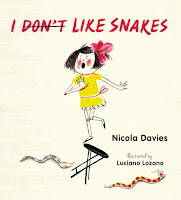
I (Don't) Like Snakes
by Nicola Davies
illustrated by Luciano Lozano
Candlewick, 2015
Amazon / Public library
ages 4-8
A young girl can't believe it, but her family really likes snakes. When she says, "I really, really, REALLY don't like snakes!" they are amazed--setting the stage for the young protagonist to explain just why she can't stand these slithering, scaly creatures with flicky tongues.

There are times that facts and knowledge help us overcome our fears. Each time this young girl tells her family why she doesn't like snakes, they tell her a little more about these amazing creatures. "Snakes HAVE to slither," said my mom. "They don't have legs, so they bend like an S and use their ribs and scales to grip. It's the only way they can move." Davies then provides more information about different types of motions: concertina slithering, serpentine slithering and caterpillar crawling.

This skillful blend of humor and information models a terrific way of overcoming our fears by learning more about them.
I Am (Not) Scared
by Anna Kang
illustrated by Christopher Weyant
Two Lions, 2017
Amazon / Public library
ages 3-6
I'm not sure about you, but I scream like crazy on roller coasters. I get terrified when I zoom along in those tiny cars. And yet I leave the ride with an incredible rush. How do you explain this blend of fear and adrenaline? And can we extend this to other fears?

 In this delightful picture book, two bears share their fears of hairy spiders, hot lava and fried ants. But what's really on their mind is the roller coaster (with a snake!) right in front of them: The Loop of Doom. With simple, bold text and exaggerated cartoon characters, Kang and Weyant deliver the message that these friends can face their fears together, and that a little fear can be a whole lot of fun.
The Thing Lou Couldn't Do
by Ashley Spires
Kids Can, 2017
Amazon / Public library
ages 3-7
Sometimes, we are convinced that everyone else can do something and there is just no way we can do it. My youngest is absolutely sure that she cannot ride a bike. Lou loves adventure, but she is terrified of heights. When her friends decide to build their pirate ship up in a tree, Lou isn't sure she can climb it.
"Lou tells them that her arm is sore. And anyway, the cat needs a walk... There are so many reasons not to try."
After deliberating and avoiding it for a few pages, Lou decides that it's time for her "to climb aboard." She struggles and groans and is sure "she must be nearly there," but when readers turn the page they discover that she's just climbed a tiny bit.

I love this ending, with its message of trying new things and persevering. Even though she didn't climb very far, it's that she can't do it yet. "She'll be back. Maybe even tomorrow. After all, Lou loves an adventure."

The review copies were kindly sent by the publishers, Disney-Hyperion, Candlewick, Two Lions and Kids Can Press. If you make a purchase using the Amazon links on this site, a small portion goes to Great Kid Books. Thank you for your support.

©2017 Mary Ann Scheuer, Great Kid Books